Deer Hunting Field

Hunting Blog

  • Hunting
    • Best Coon Hunting Lights
    • Best Treestand Safety Harness
    • Best Hunting Boots
    • Best Rubber Hunting Boots
    • Best Muck Boots For Hunting
    • Best Treestand Safety Harness
    • Best Hunting Spotlights
    • Best Elk Hunting Boots
  • Archery
    • Best Arrow Rest
    • Best Bow Sights
    • Best Single Pin Bow Sight
  • Gun, Shooting & Accessories
    • Best Bipod for Long Range Shooting
    • Best Scope For Ar 10
    • Best Shooting Rest
    • Best AR 15 Bipod
    • Best AR 15 Slings
    • Best ACOG Clone
    • Best Shot Timers
    • Best Rifle Bipods
    • Best Shooting Tripods
  • Survival
    • Survival Shelter
    • Finding and Purifying Water in the Wilderness
  • About Us

How to Cape a Deer – How To Cape A Deer For Mounting

How to Cape a Deer – How To Cape A Deer For Mounting

Deer hunting is one of the most popular categories of outdoor sports, but there are a few technicalities involved which you will learn as you go along. You will be confronted with the issue how to cape a deer from your first successful deer hunt.

You may be in the company of an experienced hunter who will show you what to do. However, you may not have this advantage. We bring you this step-by-step guide that shows you how to cape a deer even if you have never done it before. It is simpler than you imagined.

It is important to retain the head, neck, and shoulders, extracting them from the rest of the carcass and preserving them properly until you reach a taxidermist. Protecting these parts is very critical to the entire caping process which is the reason for this useful guide.

Related: Where To Shoot A Deer – Top 5 Best Places To Shoot A Deer

What you will need:

  • A sharp set of knives, preferably 2 to 3 of different sizes
  • Surgical gloves
  • Waterproof apron
  • Hacksaw Frame
  • Spare Hacksaw Blades
  • Small Screwdriver
  • Waste cloth for wiping
  • A bucket of water
  • Mug

How to Cape your Deer

We often make mistakes with the most obvious things, so it’s always a good idea to follow a set procedure, especially while doing something which you cannot redo. You can ruin a perfectly good cape without adequate knowledge. If you just follow these simple steps, you will be able to get the perfect trophy made:

Where to Start
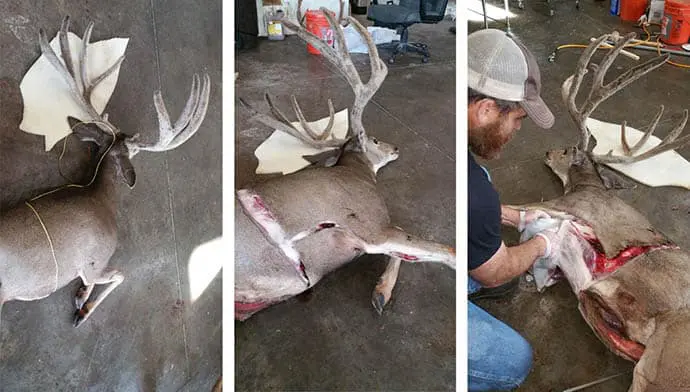
Where to Start cape a deer

Make the first cut around the midsection of the carcass, preferably around the center of the stomach.

Now cut the skin from the center of the back to the base of the head. You will have to make a short incision if it is for an early season mule or whitetail due to the relatively shorter fur.

Antlers

If your deer has velvet covered antlers, you need to part the hair between the velvet and the head skin and make a cut there. Making this incision will prevent the velvet from peeling off.

This step is only necessary on velvet-covered antlers. Part the hair between the skin of the head and the velvet and cut directly between them, separating the velvet and the hide.

FURTHER READING

➜ Best Rubber Hunting Boots

➜ Important Guidelines On How To Successfully Field Dressing A Deer

➜ Best AR 15 Bipod Reviews – The Best Bipod for AR15

Torso

Torso


Filed Under: Deer Hunting 02:20 by Kevin Steffey

Fill Your Bag: How to Find the Best Times to Hunt Rabbit

Fill Your Bag: How to Find the Best Times to Hunt Rabbit

Knowing when the best time of day to hunt rabbits are can be a bit tricky if you’re not experienced with finding them in the field.

While the furry little guys sure seem to pop up everywhere when you don’t have a weapon, there are definitely some times more ideal than others to make sure that you maximize the amount of meat and fur you can bring home while in the field.

Related: Slingshot Hunting Rabbit – How To Hunt A Rabbit With A Slingshot

How to Find the Best Times to Hunt Rabbit

1.) Legal Hunting Season

Legal Hunting Season

Make sure that you know the legal hunting season for rabbits in your area. This varies greatly from state to state, for instance in Washington it’s perfectly legal to hunt them from September 1st to March 15th, while in California the season is open from July 1st to January 29th.

Poaching is punishable by huge offenses, so make sure that you know the legal hunting times for rabbits in your area. There are also some subtle nuances to this.

If you look at the links to the Fish and Game websites above you’ll notice that it’s illegal to shoot jackrabbit at all in Washington, while in California they’re perfectly legal to take year round.

Always be sure of the species you’re hunting in order to make sure that you stay within the bounds of the law as well. If you shoot a cottontail at a distance after mistaking it for a jackrabbit, after all, you’ve still broken the law and you can be subject to some serious fines if caught by a ranger or warden.

State laws are extremely different for rabbit seasons and this makes it an entirely different kind of hunting depending on which state you’re hunting in.

Related: Rabbit Hunting With Beagles: Successful Rabbit Hunting in 5 Steps

2.) The Best Seasons

best rabbit Hunting Season

Most hunters consider the prime season for hunting, in states where it’s allowed, to be in the winter. This is more because cottontails will stand out against the snow than for any other reason.

Others contend that the best time is in the fall after a couple of freezes have occurred. This mostly has to do with a certain stigma that rabbits often carry parasites and the freeze will kill them off. For the most part, this isn’t true, although you may want to let the bodies “cool off” for a bit after you shoot them in order to allow fleas to go find other prey.

For the most part, if you’re worried about parasites then you’ll want to hunt them in cooler weather. A simple pair of latex gloves will keep you protected if you’re truly concerned about it, but most hunters won’t find it to be much of an issue.

It should also be noted that snowshoe rabbits have white pelts in the winter which can be quite attractive and look different from the normal brown and black pelts you’ll find on most game animals. This can also make them attractive to hunt in the winter if your state allows it.

FURTHER READING 

➜ What are the Best Rubber Hunting Boots – The Hunter’s Guide

➜ Best Hunting Boots On The Market » Hunting Boots Reviews

➜ Best AR 15 Bipod Reviews – The Best Bipod for AR15

3.) The Best Time of Day to hunt rabbits

The Best Time of Day

Anyone who’s spent a good amount of time in areas where there are rabbits knows that the little meat bags like to emerge whenever you don’t have a weapon. While hunting is most often a noble and skilled game of cat and mouse, hunting rabbits is almost like target shooting.

That said, you’ll want to pay attention to what time of day you venture out to find them in order to maximize your chances of bringing home your bag limit.

Rabbits are most active in the early morning and afternoon. These dawn and dusk hours are their primary feeding times and you’ll find the most action during these times. Get out a bit before sunset and find a likely location and you might be able to fill your bag before noon.

Of course, pretty much any time of day they can be found in most areas since they are primarily diurnal and are rather active animals. As long as the area is host to rabbits, then you’re likely to find some at some point.

These times of day also make for ideal scouting conditions if you’re new to hunting in an area. It’s always a good idea to know the terrain and animal behavior in an area and it can make for a nice hike or drive depending on how you do your scouting.

Look for areas with heavy activity and mark them on a map, your phone, or just make sure you can identify landmarks. You can always come back later with your gun or bow and take them since now you’ll know where they are.

Get out there early, or show up in the mid-afternoon and stay until dusk in order to increase your chances of adding some to your table and you’ll find the results quite pleasing for the most part.

4.) Weather Conditions

Weather Conditions

It might seem a bit counterintuitive, but those cold, damp days when you’d rather just stay in bed are actually the best times to get out the .22 and go rabbit hunting. So get up and get out there when the weather is mis​erable.

The key to utilizing this kind of weather condition to your advantage is the fact that rabbits will tend to “hunker down” when these conditions are present. This is because their fur isn’t particularly thick and it makes them cold. It also makes them less active, and they won’t flee quite as quickly while you’re approaching.

The ideal way to take advantage of this is to have properly scouted the area beforehand. You’ll want to find an area with dense cover with somewhere nearby where the sun is shining strongly. The rabbits will then occasionally emerge in order to warm up a bit before returning to shelter.

Conclusion

We’ve just outlined the conditions and times that’ll make for the best hunts for you. The best time of day to hunt rabbits depends on a large number of factors and even state’s laws can make it a unique experience. Don’t just rely on the best time, after all most of us have busy schedules, just make sure you get out there next season and bring home some rabbit for the table.

Questions? Comments? Let us know in the comments and we’ll get back to you.

Filed Under: Hunting 21:17 by Kevin Steffey

Top 7 Best Bird Dogs: Bird Hunting Dogs Amazing Companions for Easy Hunting

Top 7 Best Bird Dogs: Bird Hunting Dogs Amazing Companions for Easy Hunting

With so many breeds of working dog available to the prospective hunter, it can be hard to single out the best bird dogs. If you’re looking to add a lively companion to your home, however, you might want to consider one of the following in your quest to find the perfect gun dog to take with you in search of game.

Top 7 Best Bird Dogs

1.) Brittany one of good bird hunting dogs

brittany-spaniel-

One of the most renowned bird dogs in the world is undoubtedly the Brittany. Originally called the Brittany Spaniel they’re an energetic, medium sized breed of dogs which is easy to correct while training.

While most spaniel breeds are generally considered to be flushing dogs, the Brittany is primarily a pointer. This means that it will stand stock still upon coming on birds. In Britain they’re generally considered to be an HPR breed, meaning they’re expected to hunt, point, and retrieve.

There’s a reason that the Brittany is deemed such an amazing hunting dog. They’re also an exceptional companion, if a somewhat needy one, and you’ll have to devote a considerable amount of time to them.

Their reputation is well deserved however, if you can put up with them you’ll have a dog that’s a great companion and the perfect accompaniment for any fowl hunting you might participate in.

Related: Best Duck Hunting Dogs

2.) German Shorthaired Pointer

German Shorthaired Pointer

The German Shorthaired Pointer is another canine which is famous for it’s working temperament. They’re high energy and range from medium-to-large in size as well, makingthem suitable companions on hunts for larger birds.

They’re an extremely active breed, not a dog that you’ll want to leave around the house very often. If you’re engaged in other athletics along with hunting, then you’ll want to take them along otherwise their pent-up energy can be released in destructive ways.

Of course, that’s not all bad. A German Shorthair is a fast and capable companion, you’ll have to be quick on the draw to even reach your binocular harness before they’re out of sight.

They’re a true working breed, however, and they’re very good at pointing. Like most pointing dogs they’ll naturally be interested in birds of all types, which combined with their high intelligence level makes for a dog which is invaluable while in the field.

Their ability to work is pretty much biologically hardwired into their system, which makes them hardworking and dependable in the field but does require them to be more than an occasional guest on your outdoors adventures.

They’re probably best for the hunter who is active year round, but if you can keep up with them then you’ll have an even-tempered hound that makes a valuable asset while in the field.

3.) Chesapeake Bay Retriever 

Chesapeake Bay Retriever

The Chesapeake Bay Retriever is particularly of interest for those who like to hunt larger birds and waterfowl. Like their name suggests, they can be trained to easily chase down prey after you’ve landed a shot which makes things quite a bit easier on the hunter.

They love being outside, and like most retrievers are fond of swimming. They’re extremely active dogs as well, which combined with their large size and confident demeanor means that they’ll need some extra training.

They tend to be the most territorial of the retrievers and their hunting instincts are still well intact in most breeding lines. This means that you’ll definitely want to make sure that you do work them and they have high exercise requirements year round.

They’re not always the perfect dog for those who expect a hunting dog to be obedient to a fault and they’re consistently outperformed in field contests by other breeds, but the truth is they deserve a place on any listing of the best bird hunting dogs.

Their smarts and stubbornness can actually work out well for their owner, but if you find the high activity levels required and the idea of large, independent dog frightening then they may not be what you’re looking for. The rest of us will have a loyal, active working dog which is perfect for hunting water fowl and larger birds.

4.) English Cocker Spaniel

English Cocker Spaniel

The English Cocker Spaniel is a renowned flushing dog, and you’ll find that most of them can retrieve prey as well as chase it out. They’ve earned their nickname of “Merry Little Hunters” and anyone watching one in the field will quickly become enamored of their constantly wagging tail.

While many hunting dogs have exercise requirements which might push most of their humans to the limit, the English Cocker Spaniel doesn’t quite go that far. They’re certainly high-energy and athletic, but don’t require as much exercise as many working breeds.

The main drawback that most people will find is with the longer coat. They do require quite a bit of brushing and they’ll tend to shed a bit more than most people like. If you can put up with a bit of hair left behind by your hunting companion, however, they’re a great dog that can accomplish pretty much everything short of hauling a wounded goose.

They’re not the most specialized hunting breed in the world, which is often an advantage to the modern hunter since most of us don’t only go out after one type of prey throughout the year. They also tend to be rather obedient and a bit submissive, which works for those who don’t like stronger willed dogs.

If you’re willing to put up with the fur, most hunters will find them to be a boon while you’re hunting.

5.) Golden Retriever

golden-retriever

Golden Retrievers are one of the most renowned breeds of dog. From their attractive coloration to their reputation for being amazingly social and friendly, they’re an ideal companion.

The fact of the matter is, however, they were originally bred as hunting dogs and certain lineages still display an amazing aptitude for it. The problem, of course, is making sure that you buy from a breeder who specializes in hunting dogs instead of one who has been bred as a family companion.

They’re definitely large enough to handle any kind of retrieving, however, and a good Golden Retriever is simply hard to beat when you’re in the field.

If you choose carefully, there’s almost no drawback to owning one as both a hunting dog and a family pet. They tend to mellow once they’ve matured, and while they’ll require normal dog maintenance they aren’t as high energy as many, more specialized breeds and they get along with pets of pretty much any type.

There may be better hunting dogs out there, but if you want a dog to go hunting with when the season is in without a whole bunch of extra maintenance the Golden Retriever is one of the best all-around pets you can own.

6.) Weimaraner

Weimaraner

The only reason Weimaraners are less common than they should be in hunting circles has to due with the dog’s temperament. It’s not a bad thing, by any means, but these dogs were one of the few hunting breeds which were kept with the family during the day which can make them a little bit more time consuming and needy than other dogs.

The Weimaraner was originally used as a hunting dog for large game, and they’re a noble-looking breed which befits their storied history. Unfortunately, they suffered from some over-marketing in the US as a “miracle breed” which caused many to disregard them since they didn’t live up to the hyper… no dog could.

What they are is an impressively fast and powerful animal. Trust us, the first time you try to follow one with your Hunting Binocular you’re going to be rather surprised.

They need a lot of time and attention, but if it’s given to them they can be one of the best hunting dogs around. They’re generally considered as a pointer, but in truth they can be trained for any aspect of the hunt.

They’re not a good idea for those who have other pets as well, their hunting instincts are quite dominant and to train them for a specific type of game will require a lot of work on the part of the owner. On top of that, they’re definitely a “one-person” type of dog which can make them unattractive to those with families.

When properly trained, however, it’s rare to come across a more exuberant and skilled hunter. If you have the time to devote to them, you’ll be repaid with an amazing hunting dog and a fiercely loyal companion. There’s a reason many hunters use them to the exclusion of any other breed, just be aware of the drawbacks if you go with this breed.

Related: Best Rubber Hunting Boots

7.) Vizsla

vizsla

Vizsla are an impressive sight to behold. They’re a renowned hunting dog of Hunagrian origins, coming in a tightly muscled, copper colored package of manageable size. They take to the hunt like ducks to water, and many people find them indispensable in the field.

While many dogs are quite far removed from their breeds origins, the Vizsla is primarily still bred as a hunting dog. They’re considered to be some of the best “all around” dogs, meaning they can participate in flushing, pointing, and retrieving with minimal difficulty.

They’re also a bit smaller than most other dogs which are considered “all-arounders” which can be a bonus for those without a lot of room. A smaller dog doesn’t mean lesser requirements for exercise, however, and they’ll require a whole bunch of it at the end of the day.

Like all pointing dogs, they tend to require a bit of training to overcome their independent nature but this can also be an asset in the field.

As long as you can handle the exercise requirements of the breed, they make for a fine bird dog. The only issue is that if you live stateside you’ll find they’re hard to acquire and you’ll need to find a breeder who hasn’t inbred their breeding population to avoid later health issues.

As both a pet and a friend for the hunt, however, you could do a whole lot worse.

Conclusion

There are a lot of breeds of dogs which make great companions when you’re chasing after game poultry, and each dog and hunter is an individual. This makes actually choosing the best bird dogs a bit hard, but of the above breeds one is certain to meet the requirements of almost anyone.

Did we leave out your favorite breed? Interested in learning more? Leave us a comment below.

Filed Under: Hunting 19:16 by Kevin Steffey

  • « Previous Page
  • 1
  • …
  • 17
  • 18
  • 19
  • 20
  • 21
  • …
  • 49
  • Next Page »
  • AffioraTool Privacy Policy
  • AffioraTool
  • Best Shooting Rest Reviews For A Perfect Hunting – Best Shooting Rests Reviews
  • Hunting Safety: 5 Best Treestand Safety Harnesses Reviewed
  • How Fast Can A Deer Run – How Hard Would It Be To Catch A Frightened Deer On The Run
  • Rice Bran for Deer- How to Effectively Use Rice Bran to Attract a Deer?
  • The Best Reloading Scale for Consistent Accuracy
  • Which Shotgun Choke Is The Most Open?
  • 17hmr vs 22lr: Which one Should You Use?
  • 5 Top Coyote Hunting Dogs That Are Proven To Be Tremendous Hunters

DMCA.com Protection Status

Deerhuntingfield.com is a participant in the Amazon.com Services LLC Associates Program, an affiliate advertising program designed to provide a means for sites to earn advertising fees by advertising and linking to Amazon.com. Additionally, deerhuntingfield.com participates in various other affiliate programs, and we sometimes get a commission through purchases made through our links.