Deer Hunting Field

Hunting Blog

  • Hunting
    • Best Coon Hunting Lights
    • Best Treestand Safety Harness
    • Best Hunting Boots
    • Best Rubber Hunting Boots
    • Best Muck Boots For Hunting
    • Best Treestand Safety Harness
    • Best Hunting Spotlights
    • Best Elk Hunting Boots
  • Archery
    • Best Arrow Rest
    • Best Bow Sights
    • Best Single Pin Bow Sight
  • Gun, Shooting & Accessories
    • Best Bipod for Long Range Shooting
    • Best Scope For Ar 10
    • Best Shooting Rest
    • Best AR 15 Bipod
    • Best AR 15 Slings
    • Best ACOG Clone
    • Best Shot Timers
    • Best Rifle Bipods
    • Best Shooting Tripods
  • Survival
    • Survival Shelter
    • Finding and Purifying Water in the Wilderness
  • About Us

What Do Deer Eat In The Winter?

What Do Deer Eat In The Winter?

Do you ever wonder what do deer eat in the winter? Well, winter remains a tough time for any deer to survive. The chilling cold does not catch it in the comfort of its bed, but in the harsh weather in the woods.

While many deer live through January and February, the third month of the year is by no way comfortable. Any hunter would definitely want to know what such a tender animal eats with virtually most vegetation covered in snow.

What Do Deer Eat In The Winter? What Is The Ordinary Food Of The Deer?

what do deer eat in the winter snow

Like any other herbivore, the deer lives on plants, fruits, nuts, and acorns. Deer, commonly known of panting for the wells of water as they add to the aesthetic value of nature, feed on the non-woody plants, grasses, and flowering weeds. Although you may at times see a deer enjoy the fallen fruits from trees, the diet is relatively rare.

Any farmer is also aware of the presence of deer in the cultivated gardens. They are browsers of cultivated vegetables like beans, potatoes, sweet potatoes, soybeans, wheat, and rye.

Obviously, a threat to a farmer, but a hunter would seize this opportunity and aim. I bet you wouldn’t leave a presentable meal slip away in the chillness of winter, would you?

The fawns are comfortable with the mother’s milk until they can feed on the soft greens and later progress to join the deer’s diet, as hunters call it. For domesticated deer, you can use goat’s milk to feed the fawns as well; however, do not forget to warm the milk.

Related: Do You Know When To Plant Food Plot For Deer?

The Big Deal With Winter For Deer

what do whitetail deer eat in the winter

During the winter season, food becomes scarcer for a deer and the energy requirements tend to increase as the deer must keep warm. Most deer can scavenge for food in plots or the farms, and the white tail deer would rather feed on corn, cowpeas or soybeans lying on the snow. The harvested fields become preferable, as many do not like to pluck from the stalks that are standing.

However, you should note the distinction between the forest and big wood deer. How does it survive despite the change in the forest vegetation?

Although mostly inactive, their bodies still need food considering that they do not hibernate. One word should come to your mind- drop down. What does this entail? The same bushes on which the deer fed from offer a solution.

Leaves from small branches within the woods provide potential food for most deer. If the branches drop down, to the level of the deer, it can easily manage to feed on them. Any hunter should realize that deer would most likely go back to where it used to feed from to seek shelter during winter.

A Scientific Caution

However, you should note that there exists one caution in the feeding of deer in the winter. It has to do with the changing of diet for the mammal. It might sound absurd, but it is the reality- it is better not to give any food to the deer, rather than to give it a new type of food in the mid of winter.

In times of such occurrences, rarely will the animal survive. The main factor goes back to the digestive system of the animal. The deer has to eat a new type of diet for nearly two weeks before it begins to pull nutrients from the food.

Particular type of bacteria, often referred to as normal flora, which lives in the animal’s gut, assists in digestion. The bacteria, therefore, takes time to adjust to the new meal before it adapts to eating and surviving on it. Therefore, always give the deer feeds that are of the same quality as those it fed on before winter. That way, the deer can survive the tough period. You can then gradually start a change in diet.

Related: How To Plant Chicory For Deer–How to Attract Deer to Your Backyard

what do deer eat in the winter in minnesota

Down To Specifics

In the forested areas there some very peculiar feeds that the deer can make use of, especially in the mid-winter. The forest big woods deer feed on the hemlock, aspen, maple, hazel wood, and red osier dogwood. The white cedar sustains deer for hundreds of days in the deeryard. However, deer need a great deal of this food; the requirement may go up to 3-6 pounds on a daily basis. This means that the deer will have to browse heavily.

Further, many deer will enjoy feeding on the ‘Old Man’s Beard,’ which is a type of lichen resembling the Spanish moss. Since the lichens grow on dead or dying balsam and spruce trees, you can find deer looking for the ‘beards,’ which are beyond their reach.

What is again very important is to avoid any disturbance to the animal, as it should conserve most energy to survive through the winter.

FURTHER READING

➜ Best Hunting Boots

➜ Important Guidelines On How To Successfully Field Dressing A Deer

➜ Best AR 15 Bipod Reviews – The Best Bipod for AR15

Hope You Can Now Hunt Or Feed Your Farmed Deer

I hope as a good hunter or farmer, you know exactly where to go for a deer hunt or what to give your deer during the tough winter season. Just take not of different places the deer may spend time and the exact foods that most likely serve as its lunch or dinner.

Below are some links to videos on the deer eating habits in winter.

Related:All That You Need To know, What Do Whitetail Deer Eat?

Filed Under: Hunting 09:26 by Kevin Steffey

How to Cape a Deer – How To Cape A Deer For Mounting

How to Cape a Deer – How To Cape A Deer For Mounting

Deer hunting is one of the most popular categories of outdoor sports, but there are a few technicalities involved which you will learn as you go along. You will be confronted with the issue how to cape a deer from your first successful deer hunt.

You may be in the company of an experienced hunter who will show you what to do. However, you may not have this advantage. We bring you this step-by-step guide that shows you how to cape a deer even if you have never done it before. It is simpler than you imagined.

It is important to retain the head, neck, and shoulders, extracting them from the rest of the carcass and preserving them properly until you reach a taxidermist. Protecting these parts is very critical to the entire caping process which is the reason for this useful guide.

Related: Where To Shoot A Deer – Top 5 Best Places To Shoot A Deer

What you will need:

  • A sharp set of knives, preferably 2 to 3 of different sizes
  • Surgical gloves
  • Waterproof apron
  • Hacksaw Frame
  • Spare Hacksaw Blades
  • Small Screwdriver
  • Waste cloth for wiping
  • A bucket of water
  • Mug

How to Cape your Deer

We often make mistakes with the most obvious things, so it’s always a good idea to follow a set procedure, especially while doing something which you cannot redo. You can ruin a perfectly good cape without adequate knowledge. If you just follow these simple steps, you will be able to get the perfect trophy made:

Where to Start

Where to Start cape a deer

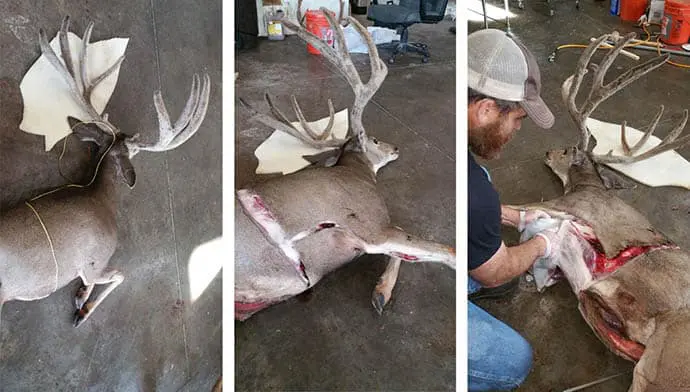
Make the first cut around the midsection of the carcass, preferably around the center of the stomach.

Now cut the skin from the center of the back to the base of the head. You will have to make a short incision if it is for an early season mule or whitetail due to the relatively shorter fur.

Antlers

If your deer has velvet covered antlers, you need to part the hair between the velvet and the head skin and make a cut there. Making this incision will prevent the velvet from peeling off.

This step is only necessary on velvet-covered antlers. Part the hair between the skin of the head and the velvet and cut directly between them, separating the velvet and the hide.

FURTHER READING

➜ Best Rubber Hunting Boots

➜ Important Guidelines On How To Successfully Field Dressing A Deer

➜ Best AR 15 Bipod Reviews – The Best Bipod for AR15

Torso

Torso


Filed Under: Deer Hunting 02:20 by Kevin Steffey

Fill Your Bag: How to Find the Best Times to Hunt Rabbit

Fill Your Bag: How to Find the Best Times to Hunt Rabbit

Knowing when the best time of day to hunt rabbits are can be a bit tricky if you’re not experienced with finding them in the field.

While the furry little guys sure seem to pop up everywhere when you don’t have a weapon, there are definitely some times more ideal than others to make sure that you maximize the amount of meat and fur you can bring home while in the field.

Related: Slingshot Hunting Rabbit – How To Hunt A Rabbit With A Slingshot

How to Find the Best Times to Hunt Rabbit

1.) Legal Hunting Season

Legal Hunting Season

Make sure that you know the legal hunting season for rabbits in your area. This varies greatly from state to state, for instance in Washington it’s perfectly legal to hunt them from September 1st to March 15th, while in California the season is open from July 1st to January 29th.

Poaching is punishable by huge offenses, so make sure that you know the legal hunting times for rabbits in your area. There are also some subtle nuances to this.

If you look at the links to the Fish and Game websites above you’ll notice that it’s illegal to shoot jackrabbit at all in Washington, while in California they’re perfectly legal to take year round.

Always be sure of the species you’re hunting in order to make sure that you stay within the bounds of the law as well. If you shoot a cottontail at a distance after mistaking it for a jackrabbit, after all, you’ve still broken the law and you can be subject to some serious fines if caught by a ranger or warden.

State laws are extremely different for rabbit seasons and this makes it an entirely different kind of hunting depending on which state you’re hunting in.

Related: Rabbit Hunting With Beagles: Successful Rabbit Hunting in 5 Steps

2.) The Best Seasons

best rabbit Hunting Season

Most hunters consider the prime season for hunting, in states where it’s allowed, to be in the winter. This is more because cottontails will stand out against the snow than for any other reason.

Others contend that the best time is in the fall after a couple of freezes have occurred. This mostly has to do with a certain stigma that rabbits often carry parasites and the freeze will kill them off. For the most part, this isn’t true, although you may want to let the bodies “cool off” for a bit after you shoot them in order to allow fleas to go find other prey.

For the most part, if you’re worried about parasites then you’ll want to hunt them in cooler weather. A simple pair of latex gloves will keep you protected if you’re truly concerned about it, but most hunters won’t find it to be much of an issue.

It should also be noted that snowshoe rabbits have white pelts in the winter which can be quite attractive and look different from the normal brown and black pelts you’ll find on most game animals. This can also make them attractive to hunt in the winter if your state allows it.

FURTHER READING 

➜ What are the Best Rubber Hunting Boots – The Hunter’s Guide

➜ Best Hunting Boots On The Market » Hunting Boots Reviews

➜ Best AR 15 Bipod Reviews – The Best Bipod for AR15

3.) The Best Time of Day to hunt rabbits

The Best Time of Day

Anyone who’s spent a good amount of time in areas where there are rabbits knows that the little meat bags like to emerge whenever you don’t have a weapon. While hunting is most often a noble and skilled game of cat and mouse, hunting rabbits is almost like target shooting.

That said, you’ll want to pay attention to what time of day you venture out to find them in order to maximize your chances of bringing home your bag limit.

Rabbits are most active in the early morning and afternoon. These dawn and dusk hours are their primary feeding times and you’ll find the most action during these times. Get out a bit before sunset and find a likely location and you might be able to fill your bag before noon.

Of course, pretty much any time of day they can be found in most areas since they are primarily diurnal and are rather active animals. As long as the area is host to rabbits, then you’re likely to find some at some point.

These times of day also make for ideal scouting conditions if you’re new to hunting in an area. It’s always a good idea to know the terrain and animal behavior in an area and it can make for a nice hike or drive depending on how you do your scouting.

Look for areas with heavy activity and mark them on a map, your phone, or just make sure you can identify landmarks. You can always come back later with your gun or bow and take them since now you’ll know where they are.

Get out there early, or show up in the mid-afternoon and stay until dusk in order to increase your chances of adding some to your table and you’ll find the results quite pleasing for the most part.

4.) Weather Conditions

Weather Conditions

It might seem a bit counterintuitive, but those cold, damp days when you’d rather just stay in bed are actually the best times to get out the .22 and go rabbit hunting. So get up and get out there when the weather is mis​erable.

The key to utilizing this kind of weather condition to your advantage is the fact that rabbits will tend to “hunker down” when these conditions are present. This is because their fur isn’t particularly thick and it makes them cold. It also makes them less active, and they won’t flee quite as quickly while you’re approaching.

The ideal way to take advantage of this is to have properly scouted the area beforehand. You’ll want to find an area with dense cover with somewhere nearby where the sun is shining strongly. The rabbits will then occasionally emerge in order to warm up a bit before returning to shelter.

Conclusion

We’ve just outlined the conditions and times that’ll make for the best hunts for you. The best time of day to hunt rabbits depends on a large number of factors and even state’s laws can make it a unique experience. Don’t just rely on the best time, after all most of us have busy schedules, just make sure you get out there next season and bring home some rabbit for the table.

Questions? Comments? Let us know in the comments and we’ll get back to you.

Filed Under: Hunting 21:17 by Kevin Steffey

  • « Previous Page
  • 1
  • …
  • 12
  • 13
  • 14
  • 15
  • 16
  • …
  • 44
  • Next Page »
  • Best Shooting Rest Reviews For A Perfect Hunting – Best Shooting Rests Reviews
  • Hunting Safety: 5 Best Treestand Safety Harnesses Reviewed
  • How Fast Can A Deer Run – How Hard Would It Be To Catch A Frightened Deer On The Run
  • Rice Bran for Deer- How to Effectively Use Rice Bran to Attract a Deer?
  • The Best Reloading Scale for Consistent Accuracy
  • Which Shotgun Choke Is The Most Open?
  • 17hmr vs 22lr: Which one Should You Use?
  • 5 Top Coyote Hunting Dogs That Are Proven To Be Tremendous Hunters
  • Best Shot Timer: Things to Know About the Top 10 Great Shot Timers
  • Elk Hunting 101: 5 of the Best Elk Hunting Boots

DMCA.com Protection Status

Deerhuntingfield.com is a participant in the Amazon.com Services LLC Associates Program, an affiliate advertising program designed to provide a means for sites to earn advertising fees by advertising and linking to Amazon.com. Additionally, deerhuntingfield.com participates in various other affiliate programs, and we sometimes get a commission through purchases made through our links.