Deer Hunting Field

Hunting Blog

  • Hunting
    • Best Coon Hunting Lights
    • Best Treestand Safety Harness
    • Best Hunting Boots
    • Best Rubber Hunting Boots
    • Best Muck Boots For Hunting
    • Best Treestand Safety Harness
    • Best Hunting Spotlights
    • Best Elk Hunting Boots
  • Archery
    • Best Arrow Rest
    • Best Bow Sights
    • Best Single Pin Bow Sight
  • Gun, Shooting & Accessories
    • Best Bipod for Long Range Shooting
    • Best Scope For Ar 10
    • Best Shooting Rest
    • Best AR 15 Bipod
    • Best AR 15 Slings
    • Best ACOG Clone
    • Best Shot Timers
    • Best Rifle Bipods
    • Best Shooting Tripods
  • Survival
    • Survival Shelter
    • Finding and Purifying Water in the Wilderness
  • About Us

How To Make A Mock Scrape For Better Hunting

How To Make A Mock Scrape For Better Hunting

If you have hunted whitetail for long or just spend much time in the forested areas, you have most likely observed some deer signs. Trails, beds, rubs and scrapes are essential kinds of deer sign that is usable by hunters to pattern whitetails and make them easy to be hunted.

But in some cases, the deer sign you discover is not situated in the best place, which enables hunting over it truly hard. However, you need to know how to make a mock scrape yourself in order to modify deer pattern of movement and acquire them nearer to a strategic hunting area or trail camera zone. If you have not utilized this strategy before, you are in for a shock. The first occasion when you discover a whitetail pausing over a mock scrape of yours for a sniff, or even better, working the mock scrape, you will eventually be conversant to this approach.

More…

Quick Navigation The Reasons for Making Mock ScrapesCreating A Mock ScrapeLocationSizeScent ControlCreating the Mock ScrapeConclusion

The Reasons for Making Mock Scrapes

There are three main reasons as to why you should create your own particular mock scrapes this hunting season, which are: attraction, distraction, and action. How about we take a closer look at each of these reasons.

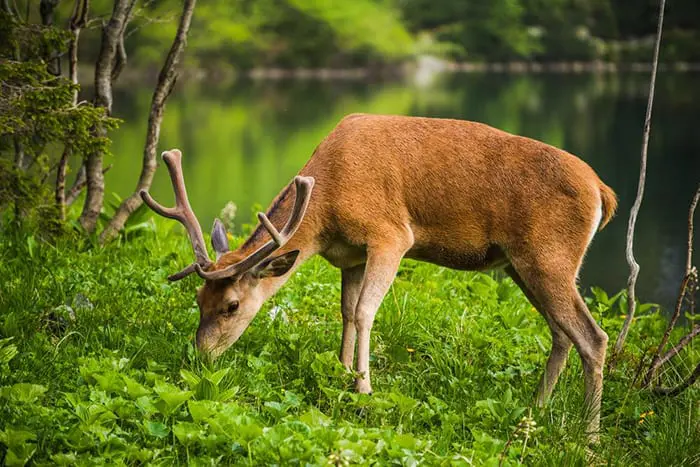
Photograph Of Deer In Velvet

Attraction

Deer enjoy utilizing mock scrapes as a means to check in with one another. Consider it as their form of an email. They store their scent into the scrape just by urinating inside it and thus putting other scents from organs. This enables other deer to be aware of their presence and enable them to know their status i.e. whether they are prepared to breed, dominance, and so forth. If they see new scrapes erupting, you can be certain that they will look at it. This makes them alluring to both bow hunting and trail camera locales.

Distraction

On the off chance that a buck finds a deer scrape in his home turf, he is actually likely to keep checking it with some normality. At least while he is available. When they review and urinate in them, they are really distracted, which takes conceivable consideration away from you or a trail camera.

Action

While the bucks are pretty much diverted by your mock scrape, it is somewhat less demanding for you to pull your bow back and have the moment needed to pull off a quiet and precise shot.

Creating A Mock Scrape

Creating a mock scrape is a strategy that is very much under-used and under-stated in most hunting locales. Although this has a tendency of working best amid pre-rut circumstances, it can give outcomes directly through the rut as deer go along the way looking for does and work scrapes. Since they are such a valuable strategy to incorporate into the deer hunting methodology, how about we now concentrate on the best way to make a mock scrape utilizing the best strategies.

Creating A Mock Scrape

Location

The first consideration before making a mock scrape is the appropriate spot good for it. If you create one in an area you cannot hunt viably, you won’t have the capacity to exploit it and it will really be an exercise in futility. Locate a good spot along a natural living space edge, where two diverse land cover sorts meet.

Deer enjoy traveling along living space edges, so you realize that deer should have the capacity to discover it once you create it. Locate a very much utilized trail along this edge for additional affirmation and a more engaged site area. However, this trail will likewise go between feeding and bedding regions, or between known doe and buck bedding regions.

Now take note of the access. Will you have the capacity to stealthily sneak in and chase the spot or is it excessively uncovered? Bucks will probably check these mock scrapes in the morning and night or all through the day as the trench approaches.

Ensure there is a tree suitable for a tree-stand downwind from the mock scrape site, ideally in a region where you will not have to cross the buck trail. Once you have recognized a spot that is suitable, it gets somewhat less complex. Simply locate a tree close to the whitetail trail with a branch at about deer head stature. This is your new mock scrape spot.

Whitetail Deer Buck

Size

It is not necessary for mock scrapes to be huge for it to function well. Almost all scrapes you find in the forested areas are just around two feet across, normally in a triangular or circular shape.

Some bigger group scrapes that are utilized by numerous deer can possibly be five feet crosswise after some time, but most of them are not that extremely huge. Go for around two feet across when creating mock scrapes as a good beginning stage. This is sufficiently huge for deer to see and simple to install.

Group Of Red Deer

Scent Control

However, as scent control is essential for low-impact hunting, it is likewise essential while creating your mock scrape in order to keep the scrape zone and the encompassing region free from any outside odors. Keep in mind, a scrape is intended to focus deer action to notice it, so they will be effectively sniffing around the region. This isn’t the ideal time to be careless with your scent control endeavors.

When going into the field to create a mock scrape, you need to put on your best scent control attire and sturdy rubber boots. Old Dominion and ScentLok have you secured. Together, they give a really strong hindrance to scent dispersal while you are creating your mock scrape or hunting. Ensure that you never try to step inside the scrape area itself, and make sure your feet are not scratching the dirt, even if you wore rubber boots.

whitetail buck

Creating the Mock Scrape

Now let us discuss how to physically create the mock scrape. Most people utilize a garden trowel to abrade the leaves far from the soil so as to make their mock scrapes. However, that could actually disperse other scents around and it is one more piece of gear to carry with you. Rather, simply get a strong branch from the territory by utilizing your latex gloves and then scratch the soil up with that.

When you are done doing that, you can just hurl it aside without the fear of raising any suspicion. Begin quickly beneath the licking branch and scratch it into the dirt, throwing the grasses, leaves and other garbage off to the edge outside. Continue in this mold till you have the right shape. And then, simply make a couple of deep gouges to uncover the dirt further. Keep in mind, deer hooves are very sharp and can cut straight into the ground quite effectively.

Conclusion

When you return to hunt in one of your mock scrape areas, you might be pretty much astounded to find out that the scrape has actually been worked oftentimes by deer going through the funnel. So, that is the ideal time to relax and receive the benefits of your endeavors. While it is not that hard to create a mock scrape, it is greatly valuable as a hunting strategy to draw and hold deer sufficiently long for making a great shot.

How would you create your own mock scrape? There are numerous options for making your next incredible deer attraction and we anticipate hearing about the accomplishment of your mock scrape endeavors! You can leave us a comment below.

Filed Under: Deer Hunting 22:18 by Kevin Steffey

Difference Between Mule Deer And White Tailed Deer

Difference Between Mule Deer And White Tailed Deer

Confusing a whitetail with a mule deer is a common wrong identification many hunters make. They have a similar look, but these species also bear many distinct differences. A mule deer vs whitetail comparison will help you hone your hunting skills.

Humans have been chasing these deer for several thousand years. Be it a mule or white-tailed deer, they all offer a unique and exciting adventure that hunters cherish.

Some hunt both, but others prefer to go after just one of them. In either case, you should educate yourself about these animals, so you don’t get confused in the field.

Please check: https://deerhuntingfield.com for more information

Mule Deer Vs Whitetail

Body Size

What does a mule deer look like? Mule deer typically have a little bigger and heavier body, even though you may have a hard time seeing this difference between whitetail and mule deer in the field.

Mule Deer

Mule Deer

The average mule deer weight in Colorado is over 250 pounds, while an Illinois whitetail buck weighs just around 200 pounds.

Nutrition, age, and environmental factors all have an impact on the mule deer vs whitetail size. And the actual size of a specific deer also varies across their range.

For example, white-tailed deer follow Bergmann’s rule, meaning their average size gets bigger in the North. It is normal to encounter Saskatchewan bucks that weigh around three hundred pounds, while small-bodied deer are a common sight in southern Texas.

This relationship between body size and latitude doesn’t apply much to mule deer.

Color Patterns

It’s as obvious as blacktail deer vs whitetail deer, but mature white-tailed and mule deer feature slightly different changes in patterns throughout the year.

A reddish-brown is the common color they have in the summer. But when the winter comes, there is a clear contrast. While mule deer typically run a more grey color, whitetails often have a tannish body.

Antlers

The antlers of whitetails are generally smaller than those of mule deer. The best explanation for this mule deer vs whitetail deer antlers is that to mule deer, antlers are their primary sexual ornaments, just like manes in male lions or jaws in male salmons.

The evolution happened in a more open country when it comes to mule deer compared to whitetail. Natural selection plays the biggest role in this and provides mule deer with big antlers so they can attract females from a far distance.

On the other hand, forests and marshes are where whitetails have evolved. These terrains have limited visibility, rendering larger antlers and their long-range attraction less necessary.

In addition to the size, the structure of antlers also sees big differences.

On white-tailed deer, single tines fork from the main beam. A typical mature buck has around 4 or 5 points on each side, including the brow tine or “eye guard”.

Mule deer antlers have a more bifurcated configuration. Their tines sprout above the beam. Most mature individuals feature four points in two forks, including two brow tines on the side.

Antlers of whitetails

Antlers of whitetails

Keep in mind that these are general descriptions. The actual structure can vary massively between individuals of each species. Many states also outlaw hunting for whitetail and mule deer spikes.

For instance, not all mule deer have forks. Some may have short brow tines, and a few of them even have none. Be cautious when deciding which species you’re seeing.

Face

White-tailed deer have less white on their faces. White tail deer faces also feature a slightly brighter forehead than mule deer as well.

Ears

There is a reason mule deer have such a name. It comes from the fact that they have relatively large ears that resemble those of mules. 

Whitetails also have large ears, but not as big as those of mule deer.

Perhaps it comes from the evolution of mule deer. It gives them such a trait, which has a better heat dissipation. In hot environments, mule deer ears can cool themselves better.

For this exact reason, many mule deer living in a colder climate have a big part of their ears frozen and missing because of frostbite.

These big ears also give mule deer a tool to detect predators in their open habitats. Many hunters have experienced this first-hand. On a calm day, the slightest movement can be noticed by mule deers several yards away.

Rumps

The rumps of most white-tailed deer have a dark, brown color.

Mule deer usually have a big white patch on their rumps, which is different from the rest of their body. This makes it easier to spot mule deer from a distance when hunting.

How to attract deer

Every hunter should master methods for attracting deer.

Heads

The face of mule deer is usually white from the eyes to the nose. White-tailed deer, on the other hand, have white rings around their nose and eyes, while their faces are mostly brown.

There is a white patch on the throats of both these species. But the larger ears of mule deer are usually set at an angle of around 30 degrees, while whitetails have round and standing erect ears.

Again, remember that between different individuals, there may be a color variation.

Does

The female individuals of mule deer typically come in anywhere between 100 and 200 pounds, while whitetail does weigh in around 90-200lbs.

Female whitetails give birth more often, often breeding for the first time at six months old. A mule deer doe needs a longer time to mature.

The gestation periods of mule deer and whitetails are around 7 and 6.5 months, respectively.

Mule deer breed in the latter half of November. Whitetails mate from late November to early December.

Fawns

These deer species have a lot in common in this department. Most first-year does have one fawn each year in May or June. Older does can deliver twins or triplets.

Most newborn fawns weigh around 6 pounds and have white spots on reddish skin. This color scheme has a camouflage purpose. They can stand within a few hours if their mothers nurse them immediately.

When fawns are still too weak to follow their mothers, the does often leave them alone and go off to feed. They often meet at mealtimes during the first few weeks.

Young fawns start to lose their white spots before the second month. It isn’t easy to tell whitetails and mule deer apart in the first month. They typically stay with their mothers for the first year.

Tails

Tails are one of the biggest clues to distinguish these species. Only the underside of white-tailed deer’s tails is white, which can be seen only when they hold their tail afloat.

Whitetails do this a lot when they want to send signals to other deer. Whitetails get their name from this part of their tails. The image of these tails held high is one of the most iconic parts of hunting whitetails.

Meanwhile, there is a wide range of bright colors on the tails of mule deer. They are smaller and usually come with a black tip at the end.

The tails of whitetails have a white underside

The tails of whitetails have a white underside

Behaviors

A mule deer typically lives in a wider home range. Most whitetails can stay within a small area (about a few square miles) around their birthplaces. The natural habitat of lowland whitetails has plenty of food resources, so there is no need for them to travel too far from their home to survive.

For mule deer, the story is different. They often spend their summer in high alpine terrain, where food sources are plentiful.

But snow levels become unmanageable when the winter comes. And mule deer are forced to move downhill to lower sagebrush and river valleys habitat.

These places provide them with more accessible food. The distance between them can go up to a hundred miles. As a result, mule deer can migrate farther than most land animals.

Unlike elk, which are grazers, whitetails and mule deer are primarily browsers. They can eat a slew of different plants. Their preferred foods are shrubs and forbs instead of grass.

That said, mule deer and whitetails also seek green grass in the spring. During the fall and winter, mule deer mostly eat sagebrush, aspen shoots, and mountain mahogany. Young saplings, acorns, food plots, and waste grain are favorites of whitetails during this period.

Dawn and dusk are when these big game animals travel and feed most actively. Whitetails and mule deer tend to rest and chew their cuds in the meantime.

In the hunting seasons, mule deer prefer shady spots near ridges, while whitetails often choose thick bedding areas to scan for danger.

These species breed or rut mostly in November. It is rare, and the offspring often don’t survive to adulthood, but hybridization between them does happen.

The rut of whitetails hits its peak during the first half of November. This period for mule deer happens in the third and fourth weeks.

During the rut, white-tailed deer are also on the move, but they don’t travel as much as mule deer. That isn’t necessary as their home range often has a high density of options to pick from.

Mule deer don’t have that benefit. They don’t have much of a choice when the densities of productive areas are lower. These bucks have to cover much more ground to find does. Their nomadic nature is also a big part of this when the winter migration is often coincident with their rut.

Both these deer species own amazing sensory capabilities in terms of hunter and predator avoidance. Their good eyesight helps them pick up movement from a long distance. They also utilize their strong sense of smell to reduce the chance of being shot at or eaten.

When their ears and eyes haven’t sensed anything dangerous yet, they can also rely on their noses.

The big ears of mule deer are also a massive advantage of theirs. But they tend to take a longer time to verify if something is actually a threat. Mule deer live in open country, and waiting for a confirmation prevents valuable energy from being wasted on long unnecessary runs.

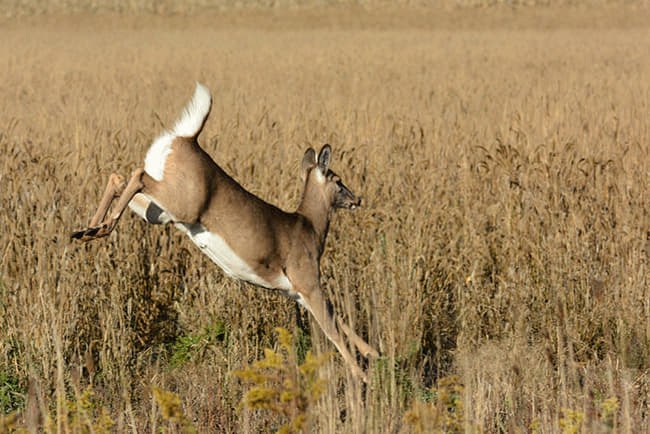
Mule deer and whitetails run in very different ways. Whitetails tend to run fast immediately with bounding leaps when they need to escape predators. Mule deer gallop or trot more slowly at first before proceeding to slot when alarmed.

Whitetail deer doe running

Whitetail deer doe running

Slotting is a unique ability of gazelles like mule deer when they lift all their body in the air with high bounds and stiff legs. Also known as pronging, this skill allows them to jump farther at downhill or uphill angles. Mule deer can also change direction in uneven terrain easier while slotting.

Spooked mule deer have a habit of stopping and checking for further running. It is very rare for hunters to see whitetails do this as they tend to spring fast to cover themselves.

Hunting

Most hunters see whitetails as the more paranoid species under pressure. This trait comes from thousands of evolutionary years, making them more experienced in avoiding predators.

Because of this, most hunters use ambush tactics to kill whitetails. It can be the best method as in the South, Northeast, and Midwest, food sources in the open look appealing to whitetails.

Hunting mule deer in the west may need different tactics. Spot and stalk is the most popular method. Learn where to shoot a deer to hunt them in the most ethical way. If you want to improve the accuracy of your shots, look at the best AR 15 bipods.

Frequently Asked QuestionsAre mule deer bigger than whitetail?

Generally speaking, mule deer tend to be bigger than white-tailed deer.

Do mule deer eat snow?

No. They typically move down out of the mountains when their food is covered by snow. 

How Big Can A Mule Deer Get?

Mule deer can range up to 7 feet long and 3.5 feet high, with a weight of up to 280 pounds. Female individuals are smaller than mule deer bucks.

Does Mule Deer Vs Whitetail Taste Better?

This mule deer vs whitetail taste is a matter of preference. Most people prefer whitetail, the reason they’re more sought after. But many also think mule deer taste as good as them. 

Conclusion

From tails to behaviors, there are many differences between mule and white-tailed deer, two of many species in North America.

In addition to the look, there are also a ton of differences in how these big game animals behave. When you’re hunting in overlapping areas where they may coexist, a good understanding of whitetail vs mule deer is a must.

[tcb-script type=”application/ld+json”]{ “@context”: “https://schema.org”, “@type”: “FAQPage”, “mainEntity”: [{ “@type”: “Question”, “name”: “Are mule deer bigger than whitetail?”, “acceptedAnswer”: { “@type”: “Answer”, “text”: “Generally speaking, mule deer tend to be bigger than white-tailed deer.” } },{ “@type”: “Question”, “name”: “Do mule deer eat snow?”, “acceptedAnswer”: { “@type”: “Answer”, “text”: “No. They typically move down out of the mountains when their food is covered by snow.” } },{ “@type”: “Question”, “name”: “How Big Can A Mule Deer Get?”, “acceptedAnswer”: { “@type”: “Answer”, “text”: “Mule deer can range up to 7 feet long and 3.5 feet high, with a weight of up to 280 pounds. Female individuals are smaller than mule deer bucks.” } },{ “@type”: “Question”, “name”: “Does Mule Deer Vs Whitetail Taste Better?”, “acceptedAnswer”: { “@type”: “Answer”, “text”: “This mule deer vs whitetail taste is a matter of preference. Most people prefer whitetail, the reason they’re more sought after. But many also think mule deer taste as good as them.” } }]}[/tcb-script]

Filed Under: Deer Hunting 20:00 by Kevin Steffey

The Best Deer Feeders (It’s Time To Attract More Deer!)

The Best Deer Feeders (It’s Time To Attract More Deer!)

Are you a wildlife enthusiast? Deer hunter? Or just an animal lover? Well, if you are any of those, a deer feeder is an important equipment you will need. Deer feeders offer a place for deer to come and eat. In line with this, you can feed the wildlife and at the same time detect the deer’s lifestyle patterns. The information can give support to the user’s hunting strategies and give better chances to a perfect timing for a great hunting experience.

In our discussion, you’ll be able to see and compare the different deer feeders and their pros and cons.

Product Name

Price

Score

Moultrie Tripod Feeders

$$$$

93/100 View Product

Redneck Outdoors T-post Gravity Feeder

$$$

95/100 View Product

Moultrie 30 Gallon Easy-Lock Tripod Deer Feeder

$$

90/100 View Product

Deer and Livestock Feeder By Zenature

$$

94/100 View Product

Moultrie 30 Gallon Easy-Lock Tripod Deer Feeder

$$$$

98/100 View Product

Note:

Identify your specific feeder needs and do a thorough research for the right feeder. This may help you save a couple of bucks. Make sure that you choose the right feeder for your personal preference and needs. Also, before jumping in with the deer feeder machine, it’s also important to have a little bit of background about the deer.

Deer in a nutshell

best deer feeder motor

De​er are herbivore animals, so they eat plants such as grass, corns, and leaves (Check Best Deer Baits). Together with this, it is important to take note that they must have to eat crude protein to maximize growth. The feed also needs to contain basic minerals such as calcium and phosphorous.

Deer are found in different places. They are mostly living in wetlands, rainforest, grasslands, and mountains. They can also be located near urban settings. They travel in groups called a herd. They are active throughout the day to find food and water. If you are a hunter, you’ll probably use a deer feeder machine to lure a deer or a herd of deer into your location. On the other hand, if you’re an animal lover, you’ll need this deer feeder to feed a herd of deer in big amounts or by batch. This is most helpful during winters because consistent feeding using a deer feeder machine can greatly help deer survive cold temperatures.

Deer Feeder Placement and Site Necessities

best deer feeder timer

It is important to know the location where the deer feeder can be placed. A strategic location can significantly affect the success of your intention with the feeder whether it’s for hunting or just simply feeding the deer. Site necessities are also important in maintaining the feeder site. Here are some factors that must be considered to plan where you will place your deer feeder machine:

1.) Propinquity or Proximity to Water

It is advisable that the deer feeder machine is placed near a body of water for the deer to drink water. The nearer the deer to this kind of resources makes the site better for the deer to also utilize natural resources.

2.) Truck Accessibility

You need access to the feeding site, and it would be helpful if your truck or AUV can easily access the feeding site for hunting or visiting purposes. Inaccessible sites may make it difficult to work around and use the feeder to its full potential

3.) Availability of other food sources in the area

This factor is very crucial because if a feeder is placed near other food sources, chances are the feeder will attract little to no deer at all. Just imagine your deer feeder machine placed next to a 300-hectare crop field. Therefore, place your feeder in a place where you can monopolize.

4.) Low-anxiety areas

Deer shouldn’t have anxiety when accessing the food feeder machine. It shouldn’t be out in the open because it might be stolen by someone passing by and it will make the deer anxious if the feeder can be easily seen by people passing by. It will help if the feeder is placed in a secluded and low anxiety areas to get better success

It is also of importance to know the site necessities in setting up where your machine should be placed. The ideal set-up for a feeder site requires trail cameras, mineral blocks, and scrapes because it adds to the usability and decoration of the site. The site should also consider animals that can be of nuisance to the area such as squirrels, raccoons and wild boars because they can hamper the operation of the deer feeder machine.

Watch this video to know how to select the right location for a deer feeder.

A Quick Buying Guide Before Buying A Deer Feeder

Deer feeders differ in shapes and sizes. However, the design should be one of the main factors to be considered before buying a feeder. Choose the right feeder with the information you are to be equipped with. These other factors should also be taken into consideration:

1.) Accessibility

best deer feeder times

Inaccessibility would defeat the purpose of buying a feeder as the deer won’t have access to the food. Deer definitely won’t come back, and the feeder would be as good as useless. Easy access is a two thumbs up but not too much access that it becomes available for all other animals besides the deer.

2.) Assembly and Installation

best deer feeder setup

Easy assembly of feeders is recommended. Feeders that are burdensome to assemble and install could lead to not being able to use the feeder to its full use and potential. It could also cause harm to the deer, and the installer as mistake and error in assembly can happen. Read the instructions well and ask for help if needed.

3.) Comfort

best deer feeder for the money

The deer must feel comfortable while eating from the feeder because any slight discomfort might shoo the deer away. The size, style, and model will all be useless if the deer feel uncomfortable. It will begin to search for another food source with more comfort than your deer feeder.

4.) Security

best deer feeder reviews

The corn from the feeder could be eaten by animals like raccoon, squirrels and other woodland animals, leaving no food for the deer. The deer feeder must be secured and ensure that no other animals besides the deer can use the feeder. It will be such a waste if all the food gets finished by other animals and still, there are no deer in sight.

5.) Cost

best automatic deer feeder

Spending too much on a feeder is not advisable as there are more affordable ones available in the market. Some feeders cost a lot of money because of certain features that aren’t even of necessity. Choose the right feeder with the right amount that pays well for its features and functions.

Top Five Best Deer Feeders Reviews In The Market Now

1.) Moultrie Tripod Feeders

61JQzLPSvaL. SL1500

Via: Amazon.com

The first entry on our list is recommended for users who want to be in control over the feeding times. This versatile feeder has programmable settings that allow the user to decide the how much and when to feed. This product has specs which can be durable on its own while at the same time withstanding knock backs from the wind. It is easy to setup because of its Moultrie Quick Lock Technology; which makes assembly a piece of cake.

Moultrie Tripod Feeders also offers a feed level estimator which is very useful in determining when to refill the feeder. It also has a battery indicator and external power port. However, one (1) 6-volt battery is required but does not come with the feeder. Nevertheless, the battery is low-priced and lasts for up to a year.

Pros

  • Mid-range price
  • Includes a built-in varmint guard
  • Metal feeder feet, metal spin plate, and funnel included
  • Has a low center of gravity and harder for animals to knock over
  • Holds about 150 pounds of corn
  • Wind resistant metal spin

Cons

  • Setup instructions are complicated
  • Difficulty in finding another battery that fits in the battery compartment
  • Cheap material used
  • Needs batteries to run and battery doesn’t come with the feeder
  • No protection from other woodland animals since it is not a metal feeder

[amazon box=”B01BE3EURU” description=” “]

2.) Redneck Outdoors T-post Gravity Feeder

71uKm9pB3VL. SL1000

Via: Amazon.com

Versatile and adjustable, this feeder suits users that have different preferences. This product is more intended and recommended for mature deer because of its height. It is built well and easy to set up as the user only needs to strap or mount it. This product’s weight capacity can hold 80 lbs. of corn. It is easy to attract deer and save time at the same time.

Redneck Outdoors T-post Gravity Feeder is made from tough heavy duty polyethylene and is designed to mount or be strapped to a tree or a post. It is ideal for rainy places as this product is designed to keep the food from getting soaked and moldy during the rain.

Pros

  • V-Groove in back intended to fit T-post perfectly
  • Easy to set up
  • Adjustable height to bottom of feeding tube
  • Low maintenance
  • Protection from harsh weather conditions

Cons

  • Accessibility of other woodland animals to the horizontal nozzle
  • Takes time for deer to get used to it probably a minimum of 3 weeks

[amazon box=”B00DPT3YAG” description=” “]

3.) Moultrie 30 Gallon Easy-Lock Tripod Deer Feeder

31jwo2KcBgL

Via: Amazon.com

Our third entry is ideal for users with a problem of feeling strained while filling up the feeder. This feeder is easy to fill with its Easy-Lock feature. The Quick-Lock design feature enables fast and easy assembly with no tools needed as this is one of the most prevalent problems of deer feeders.

Moultrie 30 Gallon Easy-Lock Tripod Deer Feeder also features a programmable digital timer and is protected by a weather-resistant box. The programmable digital timer allows you to control the feeding time and level. It is easy to use and understand even for those who are not too familiar with technology. This feeder is also perfect for places with extreme weather conditions. This product is equipped with a spin cast feeder that helps guide food out of the feeder which provides convenience and comfort for the deer.

Pros

  • Comes with a programmable digital timer
  • Good weight capacity that holds up to 200 lbs.
  • Equipped with a weather-resistant box
  • Easy to fill with Ease-Lock feature
  • Customizable feed dispense time
  • Built-in battery indicator
  • Battery lasts for a long time

Cons

  • None

[amazon box=”B000VE6L80″ description=” “]

4.) Moultrie 30 Gallon Easy-Lock Tripod Deer Feeder

61JQzLPSvaL. SL450

Via: Amazon.com

Our fourth entry is ideal for users with a problem of feeling strained while filling up the feeder. This feeder is easy to fill with its Easy-Lock feature. The Quick-Lock design feature enables fast and easy assembly with no tools needed as this is one of the most prevalent problems of deer feeders.

Moultrie 30 Gallon Easy-Lock Tripod Deer Feeder also features a programmable digital timer and is protected by a weather-resistant box. The programmable digital timer allows you to control the feeding time and level. It is easy to use and understand even for those who are not too familiar with technology. This feeder is also perfect for places with extreme weather conditions. This product is equipped with a spin cast feeder that helps guide food out of the feeder which provides convenience and comfort for the deer.

Pros

  • Comes with a programmable digital timer
  • Good weight capacity that holds up to 200 lbs.
  • Equipped with a weather-resistant box
  • Easy to fill with Ease-Lock feature
  • Customizable feed dispense time
  • Built-in battery indicator
  • Battery lasts for a long time

Cons

  • None

[amazon box=”B00ASLC5VS” description=” “]

5.) Deer and Livestock Feeder By Zenature

71vm%2BuznYAL. SL1500

Via: Amazon.com

Featuring a modest size and height, this feeder is perfect for users that seek feeders that aren’t too small or too large and just the right size. It can be used by medium to large-sized deer. It takes the deer a day or less to approach it. This product also wins in the simplicity aspect. It comes with a simple and pleasant appearance, attracting more deer. Its bottom is removable for easy cleaning.

Deer and Livestock Feeder By Zenature is simply made out of white pine wood and is assembled into a trough-style feeder. Deer are more attracted to it as it looks more approachable due to its natural component. To the deer, this feeder may seem to be just part of nature. Aside from its intended function, it can also be used for gardening purposes.

Pros

  • Affordable price
  • Holds up well against weathering factors
  • Natural components make it more attractive to deer
  • Low maintenance

Cons

  • Difficulty in assembly
  • Not well constructed and easy to knock over
  • Easy access for animals other than deer
  • Can only hold up to 25 lbs. of corn

[amazon box=”B015X65SRK” description=” “]

Verdict

Overall, the difficulty of assembly and installation has been the downside of most products. Nevertheless, Moultrie 30 Gallon Easy-LockTripod Deer Feeder has an indubitable advantage compared to the other feeders because of its commendable features while still being easy to assemble. This product is certainly on top of the game because of its good weight capacity, automated features and all other good features aforementioned while being easy to assemble.

If there is still an entry you think I should include on this list, don’t hesitate to share it in the comment section below. In the meantime, make up your mind and go to the nearest deer feeder shop to start an enjoyable experience with your new product!

Filed Under: Hunting 09:30 by Kevin Steffey

  • « Previous Page
  • 1
  • …
  • 10
  • 11
  • 12
  • 13
  • 14
  • …
  • 45
  • Next Page »
  • AffioraTool Privacy Policy
  • AffioraTool
  • Best Shooting Rest Reviews For A Perfect Hunting – Best Shooting Rests Reviews
  • Hunting Safety: 5 Best Treestand Safety Harnesses Reviewed
  • How Fast Can A Deer Run – How Hard Would It Be To Catch A Frightened Deer On The Run
  • Rice Bran for Deer- How to Effectively Use Rice Bran to Attract a Deer?
  • The Best Reloading Scale for Consistent Accuracy
  • Which Shotgun Choke Is The Most Open?
  • 17hmr vs 22lr: Which one Should You Use?
  • 5 Top Coyote Hunting Dogs That Are Proven To Be Tremendous Hunters

DMCA.com Protection Status

Deerhuntingfield.com is a participant in the Amazon.com Services LLC Associates Program, an affiliate advertising program designed to provide a means for sites to earn advertising fees by advertising and linking to Amazon.com. Additionally, deerhuntingfield.com participates in various other affiliate programs, and we sometimes get a commission through purchases made through our links.