Deer Hunting Field

Hunting Blog

  • Hunting
    • Best Coon Hunting Lights
    • Best Treestand Safety Harness
    • Best Hunting Boots
    • Best Rubber Hunting Boots
    • Best Muck Boots For Hunting
    • Best Treestand Safety Harness
    • Best Hunting Spotlights
    • Best Elk Hunting Boots
  • Archery
    • Best Arrow Rest
    • Best Bow Sights
    • Best Single Pin Bow Sight
  • Gun, Shooting & Accessories
    • Best Bipod for Long Range Shooting
    • Best Scope For Ar 10
    • Best Shooting Rest
    • Best AR 15 Bipod
    • Best AR 15 Slings
    • Best ACOG Clone
    • Best Shot Timers
    • Best Rifle Bipods
    • Best Shooting Tripods
  • Survival
    • Survival Shelter
    • Finding and Purifying Water in the Wilderness
  • About Us

Best Bipod for Long Range Shooting – 100% Accurate Buying Guide

Best Bipod for Long Range Shooting – 100% Accurate Buying Guide

It is evident that the popularity of the bipods has risen over the past decades and it is hard to find an experienced shooter who does not own one. If you want to be able to find a comfortable shooting position and achieve accurate shots, you should buy one too.

For this reason, we will try to inform you on everything there is to know about bipods and what the best bipods currently on the market are. If you are ready to learn about bipods and easily decide which one will serve your personal needs the best, just sit back and enjoy reading the rest of this article.

Image Product Name Price Score
71OjcUnheKL. SL1500 Caldwell XLA Pivot Model Bipod $$$ 95/100 View Product
91EgjPPRPeL. SL73 Tiptop® EZ Pivot & PAN Rifle Bipod $$$ 92/100 View Product
71Y3c3NzDRL. SL73 Harris Engineering 1A2-BRM Bipod $$$ 90/100 View Product
Harris Engineering S-BRM Bipod $$$ 87/100 View Product
61N7MzTtP3L. SL73

Genuine Accu-Shot Atlas Bipod BT46-LW17 PSR

$$$$$ 97/100 View Product

**Below, you’ll find our more detailed reviews, but you can also click the links above to see current prices or read customer reviews on Amazon.

More…

Quick NavigationWhat is a Bipod?Why Own a Bipod?​Types of BipodsTypes of Bipods According to Leg LengthDo You Need A Bipod or Not?The Top Five Bipods for Long Range Shooting Currently On the Market – Our Reviews1. Caldwell XLA Pivot Model Bipod2. Tiptop® EZ-Pivot & PAN Rifle Bipod3. Harris Engineering 1A2-BRM Bipod4. Harris Engineering S-BRM Bipod5. Genuine Accu-Shot Atlas Bipod BT46-LW17 PSRThe best of the best

What is a Bipod?

What is a Bipod

If you have never encountered a bipod before, we will shortly explain what it is. In simple terms, the bipod is an adjustable stand that you place the rifle on in order to achieve a more precise shot. As the name suggests, it has two (bi) legs (pod) and is basically a rather simple device used since the time of World War II.

Why Own a Bipod?

Why Own a Bipod

As already suggested, bipods are mostly usedfor the purpose of aiming accurately and achieving the best shot possible. They also allow the shooter to assume themorecomfortable position and reduce the fatigue he or she might feel when holding the rifle and aiming at the target for long.

Besides increasing shooter’s stability, they enable him or her to tilt and rotate the gun from one side to another and adjust the proper height to obtain the most desirable shooting positions. In short, owning a bipod is a sure way to achieve better shots and become a better shooter, what else could you desire?

​Types of Bipods

The bipods can be differentiated by the length of the legs. It is better to have different height adjustments since that allows you to find the best shooting position and shot more accurately. To illustrate the point, imagine shooting from a15-inch vegetation using a nine leg-length bipod- impossible, right?

Types of Bipods According to Leg Length

6-9 inches bipod They extend from 6 to 9 inches and thus offer you five different height settings to choose from. This category is the best for off the bench shooting and pistol shooters.
9- 13 inches bipod They extend from 9 to 13 inches and offer four height settings. These bipods are mostly used for prone and off the bench shooting.
13-24 inches bipod They are a bit taller and extend from 13 to 24 inches, allowing for many shooting heights to choose from. They are convenient for rather heavy or tall shooters and are ideal for snow areas.
25- 62 Inches bipod These are the longest of all Bipods as their legs can be extended up to 62 inches or about 5 feet! If you shoot in kneeling or sitting positions, this type of bipods will allow for you to be comfortable and accurate.

Do You Need A Bipod or Not?

Do You Need A Bipod or Not

There are some important features a good bipod must possess, and you should be aware of them before committing yourself as to make sure you are not wasting your money on a low-quality bipod and later regretting it. We have comprised an easy-to-follow table guide of the most important features to look for when purchasing a bipod:

Adjustable Height Although already mentioned when we have discussed the types of bipods, the adjustable legs feature is a top factor and deserves to be mentioned once again.

In other words, this feature allows you to use the bipod in different situations and makes it flexible. Regardless of the shooting position you assume, be it a prone or sitting one, you can adjust the height of the bipod and always settle comfortably and shot precisely.

​

For this reason, choose a bipod that gives you the widest range of steady height settings to choose from in your price range.

Durability Durability mostly depends on the materials that are used to construct the bipod. The best bipods are made from durable but also light weighted materials such as aluminum.

​

Avoid plastic bipods if possible as they will not last long in the fields.

Rotating/Swivel Feature Always make sure that the bipod you are buying houses a rotating or swivel stud feature.

​

It is a highly important feature as it enables a shooter to gain a stable shooting position, even when shooting from a restrictive ground.

​

Lightweight Construction ​

This is especially important if you often carry your bipod for long distances, if you are a hunter, or you engage in tactical shooting activities. Every pound counts in the fields.

​

However, be careful not to sacrifice durability for the light weight, as those two features should go hand in hand.

Rifle Sling Compatibility A bipod which allows you to attach a sling to your firearm is always a good choice as it makes carrying the rifle more convenient and reduces the possible damage you bipod or rifle might suffer.

​

Some bipods, for example, come with an extra sling mount that allows the shooter to use the sling with the bipod attached to the rifle.

The Top Five Bipods for Long Range Shooting Currently On the Market – Our Reviews

Image Product Name Price Score
71OjcUnheKL. SL1500 Caldwell XLA Pivot Model Bipod $$$ 95/100 View Product
91EgjPPRPeL. SL73 Tiptop® EZ Pivot & PAN Rifle Bipod $$$ 92/100 View Product
71Y3c3NzDRL. SL73 Harris Engineering 1A2-BRM Bipod $$$ 90/100 View Product
Harris Engineering S-BRM Bipod $$$ 87/100 View Product
61N7MzTtP3L. SL73

Genuine Accu-Shot Atlas Bipod BT46-LW17 PSR

$$$$$ 97/100 View Product

**Below, you’ll find our more detailed reviews, but you can also click the links above to see current prices or read customer reviews on Amazon.

1.Caldwell XLA Pivot Model Bipod

71OjcUnheKL. SL1500

Via: Amazon.com

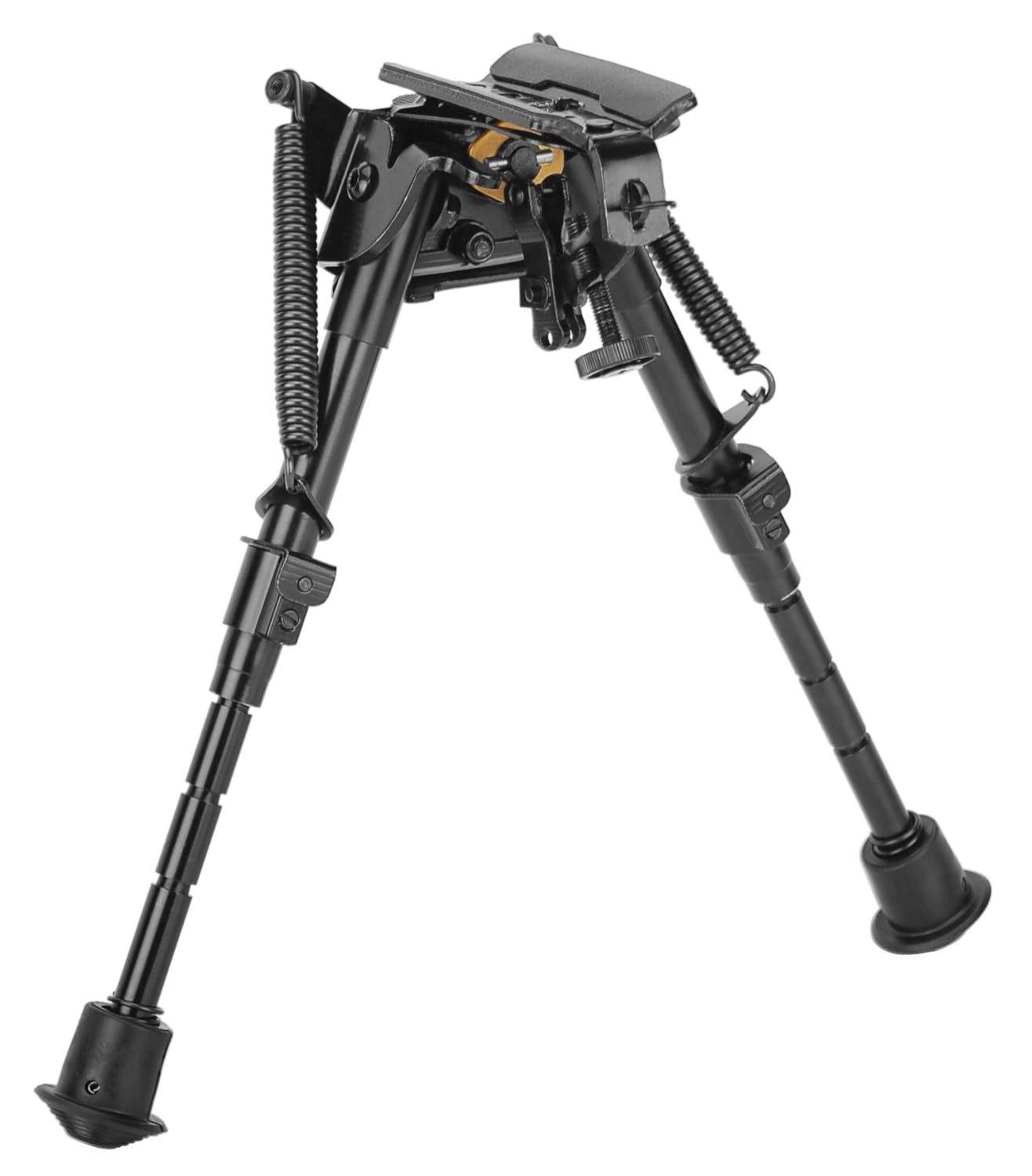
Caldwell XLA Pivot Model Bipod is available in four different sizes (6-9, 9-13, 13-23 and 13.5-27 inches) and two colors- black and camo. It is mostly made of aluminum except for the hinge pins, springs, and leg length adjustment hardware which is mostly made of steel. No tools are required as it attaches by a swivel stud and a large thumb screw on to the drop down on your rifle. It is relatively easy to attach and remove.

This bipod is designed for a rifle with the sling swivel stud. Sling guns with only a rail will not be compatible unless you purchase an adapter. The legs are very solid, a convenient button springs them out to the shooting position,but there are no thumbscrews to tighten them.

As the feet are made of rubber, the bipod is stable. The pivot allows you to compensate up to 20 degrees for uneven ground. At the back of the mounting plate, you will find a lock nut and knurled tension knob that control the amount of spring tension resistance for the pivot.

It swivels on the longitudinal axis, and that allows you to tilt left andright to level the crosshairs.It is ideal for hunting but not as suitable for bench rest target accuracy.

Pros

  • Notched legs to quickly adjust to the desired height
  • Quick adjust legs

Cons

  • No positive leg locks
  • Not suitable for target accuracy

[amazon box=”B0032MUIL4″ description=” “]

2. Tiptop® EZ-Pivot & PAN Rifle Bipod
91EgjPPRPeL. SL1500

Via: Amazon.com

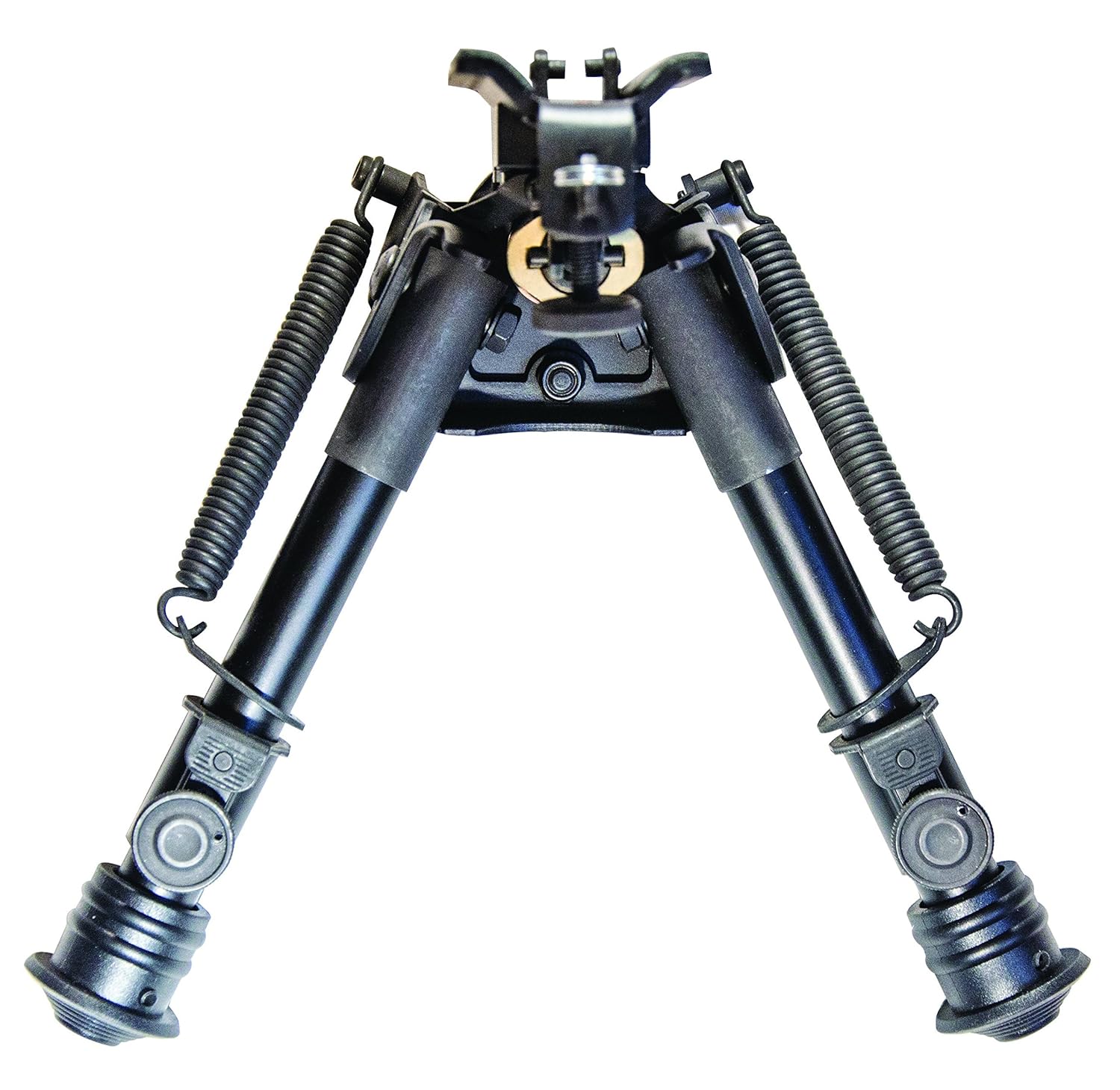
Made of aircraft grade alloy, Tiptop® EZ-Pivot& PAN Rifle Bipod has a black anodized finish which reduces reflection and is rust resistant. The telescopic legs are adjustable from 6” to 9” and can be folded parallel to the barrel which allows for easy carrying and storage. The legs snap out and retract smoothly and quietly, and their rubber base prevents the slipping.The engraved tiptop is useful for achieving maximum accuracy at shooting.

It supports all gun weights and features a standard stud sling just below the tension leverto which you can attach a slingwhen needed. The pivot allows for up to 34 degrees adjustment on uneven terrain,and there is also a pan for thehorizontal scan to 40 degrees. Pivoting and horizontal scan can be done simultaneously which is very convenient.

Due to the length, this bipod is most suitable for prone shooting, bench rest, and floor use. It is appropriate for precise targeting sincea special spring load holds it in a strong and steady position.

Pros

  • Durable and stable
  • Adjustable and fold able legs
  • Lightweight
  • Simultaneous pivoting and horizontal scan
  • Inexpensive

Cons

  • Somewhat complicated attachment mechanism
  • The legs are not notched
  • The legs are spring loaded to retract but do not spring out

[amazon box=”B00QJ67A1Q” description=” “]

3. Harris Engineering 1A2-BRM Bipod
71Y3c3NzDRL. SL1500

Via: Amazon.com

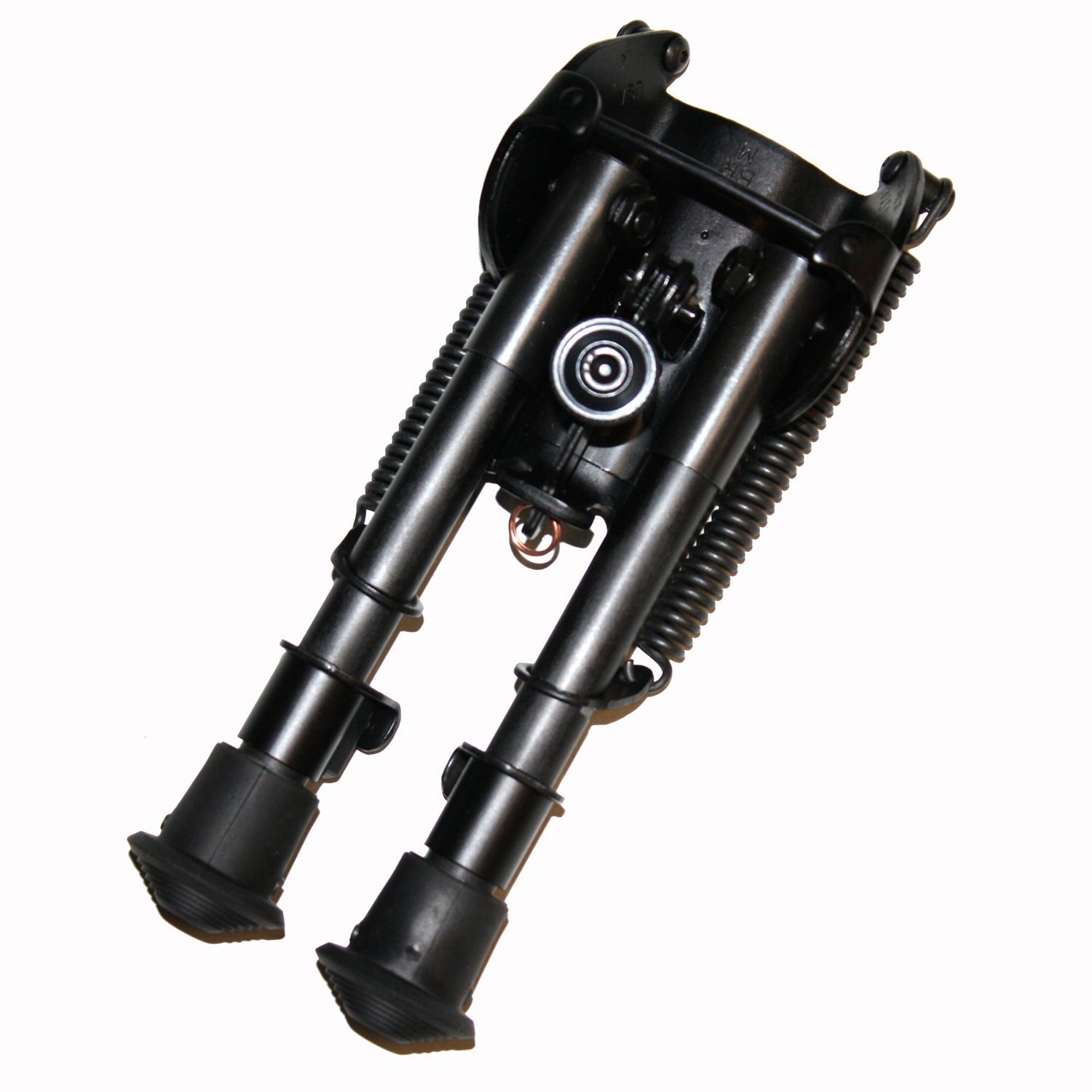
Harris Engineering 1A2-BRM Bipodis made ofheat treated steel and hard alloys with a black anodized finish. It is rather light as it weighs around 10 ounces but appears well-built and sturdy as well. It is easy to attach to any rifle with a swivel stud; if your rifle has only a rail, you will need an adapter.

It is a brand made in the USA, used by military and highly appreciated by many shooters.On the downside, there is no swivel, and it does not pan or rotate. However, it functions well enough for users who are not exceptionally demanding as they can adjust each notched leg individually on uneven surfaces. The legs turn up or down without any delay;you adjust the length by pushing a small button- they are spring loaded and will extend until contact with the ground.

The 6-9 inch version should be primarily used for targets as that is the best height for this application. For in the field use you might want to buy a taller bipod.

Pros

  • Lightweight and sturdy
  • Easy to attach
  • Notched legs allow adjustment by 1 inch
  • Affordable bipod of a well-known brand

Cons

  • Does not pan or rotate
  • No swivel
  • Not appropriate for in the field usage

[amazon box=”B000JJL81M” description=” “]

4. Harris Engineering S-BRM Bipod
Via: Amazon.com

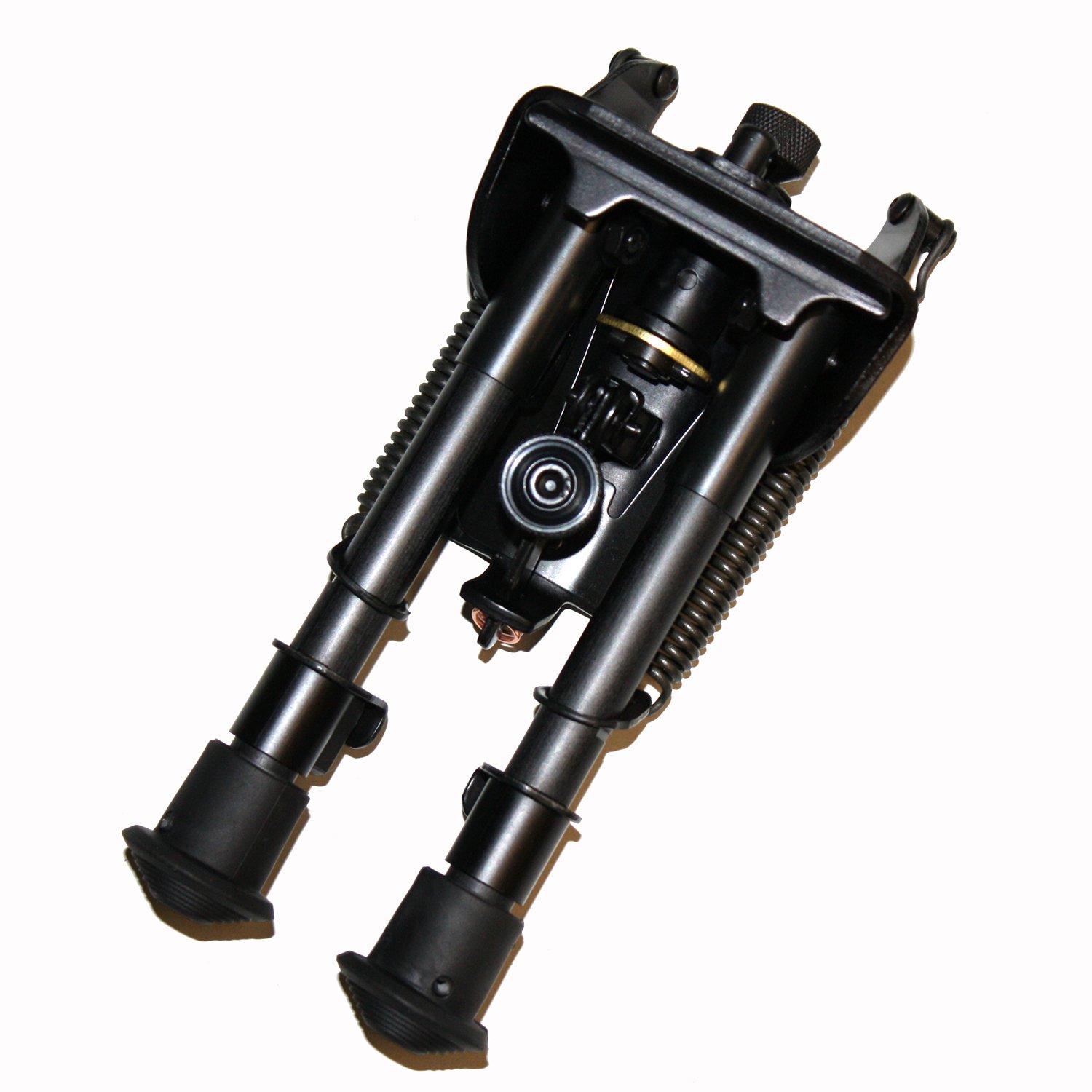
Harris Engineering S-BRM Bipodis made of high-quality aluminum alloy and heat treatedsteel parts; it is lightweight and heavy-duty at the same time. The black anodized finish allows for it to be used in all weather conditions. The construction quality is excellent,it is quick-detachable and does not obstruct shooting off-hand or carrying your rifle with a sling.

As all the other bipods reviewed so far, it is not designed to affix to a standard rail but a swivel stud or an adapter instead. A sling swivel can be mounted to the bipod’s swivel stud clamp. The legs can extend from 6 to 9 inches and when not in use they easily fold up against the rifle.

There are rubber feet on the end of each leg which add stability and prevent slipping while shooting.To eliminate tremor and looseness in the crotch area, this bipod is armed with tension adjustment of hinged bases.

The only criticism we can address to the Harris S-BRM is that it is a bit noisy to work with which might bother hunters the most. It is an excellent choice for bench/table or prone shooting.

Pros

  • Solid support
  • Easy to adjust and fold spring loaded legs Rubberized feet for steadiness.
  • The flawless hinged base for maximum fitting.
  • Durable.
  • Easily attachable/detachable

Cons

  • Noisy to work with
  • The tilt lock knob cannot be hand-tightened
  • No locking lever to lock the swivel in place

[amazon box=”B000JJGXAI” description=” “]

5. Genuine Accu-Shot Atlas Bipod BT46-LW17 PSR

61N7MzTtP3L. SL1500

Via: Amazon.com

Accu-Shot Atlas Bipod BT46-LW17 PSR is the most expensive bipod we have reviewed. It is designed with precision, made of quality aluminum alloy and weighs 13.61 ounces. If you do not regret spending the extra money, you will surely find this bipod to be a stable platform for your precision rifle regardless of its weight or the terrain used on. It easily mounts straight to any Pica tinny rail thanks to the ADM 170-S Lever.

You can adjust the notched legs easily from 4.75-inches out to 9-inches. There are five pre-set height settings which allow you to find the best angle for an accurate long-range shot more quickly. The non-rotating legs can be locked at 45 or 90-degree angles and have the interior build of T7075 aluminum securing a more steady position.

The preload can’t and pan features allow for right and left movement and leveling. This allows you to search the scene for targets without moving the entire gun. Pivot limiting bosses at the front and the back, and the reinforced leg bosses enable the quick PSR adjustment to any state. Excellent for precise long range shooting.

Pros

  • Preloaded Pan and Cant of 150 and more
  • Front and rear Pivot limiting bosses
  • High quality and flexible unit
  • Mounts on all Picatinny rails
  • Notched legs

Cons

  • You must move every leg separately
  • High-price

[amazon box=”B00R3OQQ7W” description=” “]

The Best of The Best

We have paid special attention when choosing the bipods to review, and for this reason, you will not regret buying any of them. However, there is always the best even among the best, and in this case, that is Tiptop® EZ-Pivot & PAN Rifle Bipod. It balances the price and quality perfectly and offers some excellent features that will secure the most precise targeting and shots.

If money is no issue for you, and you want the most luxurious bipod on the market that will never fail you and have all the features you could desire already incorporated go for Genuine Accu-Shot Atlas Bipod BT46-LW17 PSR.

In any case, owning a bipod will greatly benefit your long range shooting making it more accurate and thus more enjoyable, quickly choose and buy one and become the best shooter you can be.

Filed Under: Bipods-Tripods-Rest-Shooting Bags Tagged With: Guns & Shooting Supplies 09:17 by Kevin Steffey

What Are The Basic Parts Of Ammunition?

What Are The Basic Parts Of Ammunition?

Most people have seen a bullet or shotgun shell, but have you ever wondered “What Are The Basic Parts Of Ammunition?” It may be surprising, but even some very experienced hunters and gun enthusiasts overlook the material construction of the ammunition they load into their weapons. Whether you handle ammunition often, or have a passing curiosity, knowing how ammunition is made can be valuable information.

Knowing how ammunition is constructed can help you to better assess a potential purchase. Inferior chemicals, materials and processes can contribute to a loss of performance and safety when firing weapons. Understanding the value of quality components can help you understand the price differences in the ammunition market and guide your choice appropriately. While there are often exceptions to any particular rule, in essence there are five basic components of ammunition manufacturing.

What Are The Basic Parts Of Ammunition?

Propellant

The propellant is the combustible component that, when ignited, creates a sudden, but contained detonation. The expansion of the gases created by the detonating propellant push the projectile forward and out of the barrel. They chemical make-up and amount of propellant has a direct result on the speed and velocity of the projectile.

A compound, known as smokeless powder, is the most common propellant used in today’s ammunition. There is no single propellant formulation known as “gunpowder,”rather every ammunition manufacturer, including people who reload their own bullets, choose a particular combination of chemical compounds they believe to produce the best results.

The difference between black powder and smokeless powder:

Primer

Ammunition propellant is typically a very stable substance that can be stored almost indefinitely if left undisturbed. Some method to cause the initial ignition of the propellant is required. This is the role of the primer.

Primers are explosive chemicals that ignite when compressed. In order to perform their role in a most efficient manner, the primer is located at the bottom end (the side opposite of the projectile). The primer is activated either by a pin striking the outer rim of the case (as a rimfire), or in a specially designed compartment in the center of the case (as a centerfire).

Related: What Is The Main Difference Between Centerfire And Rimfire Ammunition

Wad

what are the basic parts of ammunition quizlet

In order for a firearm to take full advantage of the rapidly expanding gas inside the chamber and barrel, it is essential to ensure that the full volume of escaping gas is fully expelledin only one direction. To prevent stray gasses from finding an alternate path, a paper or plastic seal is placed between the propellant and the projectile.

This “wad” is projected forward with the expanding gas and seals the barrel so that there is little to no gas escaping the barrel before the projectile exits.“Blanks,”is a name given to ammunition without a projectile.

This type of ammunition still uses a wad at the end of the case to hold the propellant in place until it is fired. When a “blank” discharges, the wad presents a real danger for several feet outside the barrel of a firearm, thus never assume that blanks are “safe.”

Projectile

what are the parts of ammunition

An ammunition projectile is the component that leaves the barrel as a result of the expelled gas. Often referred to as a “bullet,” ammunition projectiles can take on several different forms. Projectiles can also take to form of several small balls, or shot, which leave the barrel and spread into a wide pattern. This shot is typically made from steel, tungsten, bismuth or lead.

Lead is also the common material used in making bullets. These lead projectiles can be formed into one of many different shapes depending upon the purpose they are designed for. Aside from lead, bullets are also made from special plastics or rubber bullets for use as non-lethal (or less-than-lethal) projectiles.

For more on bullet designs see this video:

For more on shotgun projectiles see this video:

The Case

The ammunition case is the central part of ammunition that holds all of the individual parts together. They may appear to be simple in their appearance, but the ammunition case may likely be the most underrated component of the entire assembly.

There is much said about different bullet designs and characteristics as well as the amount of propellant used to send the projectile down range. What goes often overlooked is the amount of time invested in designing the perfect case for a given type of ammunition.

Firearms are designed to exacting precision when it comes to the size of the ammunition they use, thus the size of the case is limited to the particular projectile and firearm it is intended for. The case must be properly designedto withstand the force of the expanding propellant and ejection mechanisms of different firearms.

A poorly designed case may cause weapon malfunction or injury to users. Weight and corrosion are additional factors that play an important role in the design of ammunition cases. As a result, the material most typically used in manufacturing ammunition cases iscopper, brass, or steel. Due to their own unique characteristics, shotgun shells are made from plastics or specialized paper material.

Knowing how your ammunition is made can help you better understand the proper safety procedures to use when storing, transporting, and using it. Brass and copper constructed ammunition stores much better than steel since steel will corrode and rust when exposed to moisture or humidity.

Steel is still used though because of its exceptional strength under pressure. This means that a higher power cartridge may benefit from steel construction, but such an item would not be recommended for long-term storage.

Watch how Creedmore Sports makes their ammunition:

Rather than purchasing store-bought ammunition, many people chose to load their own cartridges. If this is something you may be interested in, it would be wise to do your research into the different shapes, sizes, and materials available for this purpose. Stick with tried and tested methods that provide consistent, safe results.

The more experience you gain in loading your own ammunition, the more you will understand the various areas where you can experiment and other areas that must adhere to strict safety protocols.

FURTHER READING

➜ How Far Can A Bullet Travel? How Far Does A Bullet Travel

➜ A Comprehensive Guide on How to Make Exploding Targets

➜ Where To Shoot A Deer – Top 5 Best Places To Shoot A Deer

Conclusion:

There are many great reasons for the popularity of handling and firing ammunition. Just make sure that you understand the variables, potential dangers, and benefits of proper ammunition construction.

Knowing how ammunition is constructed will prepare you to handle and store ammunition in a safe manner. You may be in a position now that you may have even more questions and that is okay too. There are some wonderful resources online that can provide you with the answers you seek.

Filed Under: Gun, Shooting & Accessories 09:00 by Kevin Steffey

How Should Firearms Be Transported In A Boat? (The Answer Is Not That Easy!)

How Should Firearms Be Transported In A Boat? (The Answer Is Not That Easy!)

Transporting firearms in a boat or any sea vessel is not a tricky business. It goes especially for those who are attuned with the prescribed laws in their states or country. But for those who are oblivious to this fact, a huge trouble could be looming for them. Whether it will cost them their safety or worse, some hefty legal charges, one should be adept in knowing how should firearms be transported in a boat.

This article will focus solely on answering that question. And as this query requires some specifics like your destination, your current location, and which type of boat you’re on, we’ll attempt to respond to this as generally as we can. And right before our closure, we’ll give you some simple tips on how to board your firearms in your boat.

More…

Quick NavigationThe General Law On Transporting Firearms In Your BoatCarrying Rifles And The Accompanying ReasonsSailing Overseas With FirearmsSafest Ways To Transport Firearms In A BoatFinal Thoughts

The General Law On Transporting Firearms In Your Boat

how should firearms be transported in a boat boat ed

We’re treating the question under this discussion generally as specifics are not readily available. As such, if you want to know the real deal on the laws that govern on transporting firearms in a boat, you may refer to the corresponding law in your state.

Now, the laws that apply to possessing firearms in boats are similar if not exact to those that are being regulated when you’re on land. As a starter, ensure that you look first for the very purpose as for why you’re carrying or transporting that firearm whenever you decide to do it when you sail or run your motor on water or even on internal waterways.

On the other hand, if your firearm in your boat is used en route to a deer country, that activity may be deemed legal. However, some states still have varying modifications on this, so it is crucial that you determine this first before embarking on this. If it is truly legal, the next thing you need to make sure of has something to do with the firearm’s security in your boat. It is easy as it should be similar to how you carry a firearm in a car.

Carrying Rifles And The Accompanying Reasons

how should firearms be transported on a boat

Fishing while carrying a rifle on a boat is another story. This one warrants you to possess a license for this kind of endeavor. As such, you need to confirm a legitimate reason for possessing a firearm on a boat. Similarly, this can be done right when you’re on a motor vehicle as you procure the requirements for its storage.

The established, legitimate reasons that are accepted vary depending on the laws in a country or a state. For example, self-defense can be a valid reason in some countries, but in nations like Australia, it’s a whole new, different angle. For hunting purposes, when a property is owned by someone, you’re going to have to get that permission to hunt first.

There are instances too in which the country’s customs department should have to be alerted when passing through their location via a yacht or any motorized vehicle. Whenever they obtain the firearm’s possession, this country may likely require you to have a one-week notice of your departure to return it accordingly. Some foreign countries would even go to great lengths like arresting you or seizing both your firearm and the boat should you get caught with a firearm in your sea vessel.

Sailing Overseas With Firearms

how should guns be transported in a boat

When you go a​broad with a firearm in a boat or any other sea vessel, it is advisable that you acquaint yourself first with the laws in each country that you intend to visit. Also, ensure that these firearms are disclosed to their Customs respectively, right when you have arrived in the locale. As some countries are stricter, you have to make certain that there is a disclosure for these firearms. Otherwise, you’ll be charged for smuggling firearms.

Ultimately, an utter disclosure still won’t save you in other countries. There are still locations that will prosecute you regardless of this. The only way to get out of this is clearly to prevent it from happening in the first place. A thorough research on the laws in these countries is one.

And now that we’re equipped with some of the general law for transporting firearms in a boat, let’s get into the ways on how to properly carry them in a boat.

Safest Ways To Transport Firearms In A Boat

how should firearms be transported in a boat in missouri

Just like the laws that are associated with firearms in a boat or a motorized vehicle, the means to transport your guns in both cases are also similar. Simply, unload and case the firearms before you place them in any sea vessel. Moreover, the action has to be open, or the gun should be broken down as long as they are its safest.

Right before you board the boat, you need to put the unloaded gun in the bow or front of the boat. The firearm’s muzzle should be pointing forward.

You also need to consider the position of your firearm when you’re not hunting alone. When you’re accompanied, the first person (yourself, for example) has to settle in the bow position while facing forward when the first gun is put on. After that, the other person’s unloaded firearm right in the boat’s rear has to have its muzzle pointed rearward. Only then, this person can settle in the stern with a position that faces rearward, too. The unloading part also has to repeat the procedure.

Final Thoughts

The laws that surround the transport of firearms on sea vessels such as boats are complicated. They come varying from state-specific laws, national laws, and international laws. And as what I’ve emphasized earlier, there are instances in which these laws are stricter than the other. You may have come around dodging a charge from this country, but that doesn’t mean that you can do that to another. The key is to ensuring that you research these laws thoroughly before circling in on these locations.

Meanwhile, transporting firearms in a boat is very easy in terms of doing it. Those simple steps must be followed for everyone’s safety.

Filed Under: Gun, Shooting & Accessories 19:08 by Kevin Steffey

  • « Previous Page
  • 1
  • …
  • 23
  • 24
  • 25
  • 26
  • 27
  • …
  • 44
  • Next Page »
  • Best Shooting Rest Reviews For A Perfect Hunting – Best Shooting Rests Reviews
  • Hunting Safety: 5 Best Treestand Safety Harnesses Reviewed
  • How Fast Can A Deer Run – How Hard Would It Be To Catch A Frightened Deer On The Run
  • Rice Bran for Deer- How to Effectively Use Rice Bran to Attract a Deer?
  • The Best Reloading Scale for Consistent Accuracy
  • Which Shotgun Choke Is The Most Open?
  • 17hmr vs 22lr: Which one Should You Use?
  • 5 Top Coyote Hunting Dogs That Are Proven To Be Tremendous Hunters
  • Best Shot Timer: Things to Know About the Top 10 Great Shot Timers
  • Elk Hunting 101: 5 of the Best Elk Hunting Boots

DMCA.com Protection Status

Deerhuntingfield.com is a participant in the Amazon.com Services LLC Associates Program, an affiliate advertising program designed to provide a means for sites to earn advertising fees by advertising and linking to Amazon.com. Additionally, deerhuntingfield.com participates in various other affiliate programs, and we sometimes get a commission through purchases made through our links.