Deer Hunting Field

Hunting Blog

  • Hunting
    • Best Coon Hunting Lights
    • Best Treestand Safety Harness
    • Best Hunting Boots
    • Best Rubber Hunting Boots
    • Best Muck Boots For Hunting
    • Best Treestand Safety Harness
    • Best Hunting Spotlights
    • Best Elk Hunting Boots
  • Archery
    • Best Arrow Rest
    • Best Bow Sights
    • Best Single Pin Bow Sight
  • Gun, Shooting & Accessories
    • Best Bipod for Long Range Shooting
    • Best Scope For Ar 10
    • Best Shooting Rest
    • Best AR 15 Bipod
    • Best AR 15 Slings
    • Best ACOG Clone
    • Best Shot Timers
    • Best Rifle Bipods
    • Best Shooting Tripods
  • Survival
    • Survival Shelter
    • Finding and Purifying Water in the Wilderness
  • About Us

Kentucky Deer Hunting – How Do I Legally Hunt Deer In Kentucky?

Kentucky Deer Hunting – How Do I Legally Hunt Deer In Kentucky?

If you’re in the mood to hunt whitetail, then at some point Kentucky has come onto your radar. It’s a state well known for excellent deer hunting spots and friendly locals- but do you know everything you need to about deer hunting in Kentucky? Never fear, we’re here to give you all the lowdown you need to stay on the right side of the law and still have fun.

More…

How Do I Legally Hunt Deer In Kentucky?What Are The Legalities For Kentucky Deer Hunting?What Seasons And Firearms Does Kentucky Offer?I’ve Hunted In Kentucky Before- What’s Changed?Must I wear hunter orange?What Are Kentucky’s Bag Limits?What Deer Will I Find In Kentucky?

What Are The Legalities For Kentucky Deer Hunting?

As with most areas in the US, you will need permits to undertake deer hunting legally in Kentucky. A photo ID and proof of your permit purchase must be carried at all times during the hunt.

You will need both an annual hunting license and a statewide deer permit. These will allow you a total of one antlered and one antler

less deer. Additional deer permits will allow you another two deer. Remember that the statewide regulation is one antlered deer only.

deer antler

What Seasons And Firearms Does Kentucky Offer?

Deer hunting seasons in Kentucky are mostly governed by hunting weapon type. The state offers archery and crossbow seasons, muzzleloader seasons and modern firearm seasons. Many of these do overlap, and the use of some types of weapon are prohibited during parts of another’s season.

The state department offers an exhaustive breakdown of each season type with regulations for both youth and adult hunting, so be sure to check your area carefully. The entire deer hunting season in Kentucky runs from roughly mid-September to mid-January so plan accordingly.

I’ve Hunted In Kentucky Before- What’s Changed?

If you’re an old hand at hunting in this state, there are just a few things to bear in mind. As of March 2016, there have been a few changes of counties between zones. Webster, Marion, and Hardin counties are now classified differently. Grayson Lake and the youth portion of Knobs State Forest are now open under statewide regulations, and Higgson-Henry has dropped their one deer bag limit in favor of statewide limits.

Hunters may now bring one non-hunter companion along. While this person does not need a permit, they are required to check in and out with the hunter and abide by hunter orange rules. Big Rivers has changed its quota hunting laws quite extensively, and the Land between the Lakes area now counts towards state-wide quotas- deer taken there are no longer ‘bonus’ deer. For archery season this area has a bag limit of one.

Red Deer Stag in the mist

Must I wear hunter orange?

Yes. Hunter orange laws apply for both you as the hunter and any non-hunting companion you take along. A cap and vest usually are enough to comply with regulations. Mesh vests are allowed provided the holes are not greater than ¼”, but hunter orange camouflage often doesn’t meet requirements- rather opt for solid orange on the head and chest such as in this example

What Are Kentucky’s Bag Limits?

As a deer hunter in Kentucky, it is, of course, critical to abide by the mandated bag limits. There is no daily quota, but depending on your hunting zone there are overall quotas.

  • Zone 4 areas have the trickiest regulations- deer without antlers may only be taken by youth during appropriate youth seasons, or for the last three days of the December season by hunters using muzzleloaders. The rest of the time there is a two deer limit, only one of which may be taken by firearm [the other must be by muzzleloader].
  • Zone 1 is far simpler- there are no bag limits on deer without antlers here.
  • The other three zones all allow the taking of one antlered and three antlerless deer, or four antlerless deer, over the season.
  • Zone 3 has the added restriction of only allowing two of these deer by firearm.

Remember that for all deer hunting in Kentucky, regardless of area, you are allowed only one antlered deer. They do usually make an exclusion for button bucks. Additionally, some federally controlled areas do allow for an antlered ‘bonus’ deer- be sure to check the specifics of your area on the Kentucky department of fish & wildlife’s page.

What Deer Will I Find In Kentucky?

Kentucky is famous for some of the best white-tailed deer hunting there is in the US. In a pretty fantastic initiative, Kentucky also offers ‘hunters for the hungry.’ If you opt not to take the meat of your kill back with you, there are drop-off spots for the carcasses to be cleaned and donated to help the hungry- what better initiative to turn an enjoyable hunt into a responsible one too?

Here’s some bagging their big-antler deer in Kentucky

Hunting deer in Kentucky is one of the highlights of the hunting calendar, particularly if you are looking to net yourself a bid-antler or lifetime buck. Do remember to get your legally authorised hunter orange vest for the hunt though.

With this quick and easy reference to take the pain out of following the rules, you’ll soon be on your way to the hunt instead of stressing over regulations.


Are you fully legally compliant for your Kentucky Deer hunt? Have you have good experiences getting your permits from the state? Let us know your experiences in the comments below

​

Filed Under: Hunting, Deer Hunting 02:42 by Kevin Steffey

How to Measure Draw Length – Acquiring the Best Archery Skills

How to Measure Draw Length – Acquiring the Best Archery Skills

Developing excellent archery skills involves some precise techniques which have a scientific basis. There are several parameters involved and one main factor which influences the accuracy of your shot is knowing how to measure draw length.

While other things like knowing how to determine draw weight, how to determine arrow length, recurve bow draw length and bow length are also important, we shall focus on the process of drawing a bow and arrow in this article.

The issue regarding draw length while shooting is something well-understood by veteran marksmen. However, if you are new to bow hunting, you might make the same assumption that many archers do, which is that if you have bought a branded bow and arrow, the draw length should be adequate and the arrow designed to fit the draw length of the bow. Why then should we have to get involved in knowing how to measure draw length or how to adjust it?

FURTHER READING

➜ Best Elk Hunting Boots

➜ Best place to shoot a deer

➜ 7 of the Best Deer Baits (#5 Will Surprise You!)

The answer to this question is quite logical. You can buy a set of bow and arrows and start shooting right away. However, to optimize the accuracy of your shot, you need to make a few fine adjustments to both the bow and arrows. If you can measure certain parameters, you will be able to control the way your bow shoots arrows and which is why I felt it important to explain how to measure draw length for a better shot.

Required Materials

Bow hunter in field pulling back arrow on compund bow.

You will need to have some basic stuff at hand to prepare for this simple procedure. The actual process is quite simple, and the measurement is not likely to take more than a minute. You can vary the materials slightly according to availability, but I have just listed the basic stuff to get the job done. Here’s what you should have ready:

  • A wall with a corner (for the first method)
  • Pencil or whiteboard marker
  • Tape measure
  • Calculator
  • Writing pad to jot down the figures

There are several methods of measuring draw length, and here are the three most popular ones:

Method – 1: (Wingspan/2.5)

1. Holding the pencil or marker in your right hand, face the wall

2. Note a fixed point on the wall (a corner or a joint in the tiles or paneling)

3. Place your left hand on the fixed point

4. Still facing the wall, outstretch your arms as far as is comfortable

5. Now, with your arms still outstretched, mark off the furthest point with your pencil or marker

6. Release your arms and measure the distance between the two points in inches

7. Divide the figure by 2.5

8. The resulting number you get is the exact draw length of your bow

Method – 2: (Buttons to Base)

1. Hold the tape measure in your right hand

2. Place the tape measure at the point where you button your shirt

3. Now, hold the tape measure at that point with your left hand

4. Extend your right arm sideward to your right, keeping the tape as you do so

5. With your right hand extended, have someone to measure the distance from your chest to your wrist with the extended tape measure

6. The length of the measuring tape is your bow draw length

Method – 3:(Fist to Mouth)

1. Hold the tape measure in your left fist against the wall

2. Pull it back with your right hand as if drawing a bow until your hand touches your mouth

3. Measure the distance from the top of your fist to the corner of your mouth

4. The resulting length is your bow’s draw length.

Draw Length Vs Arrow Length

Draw Length Vs Arrow Length

Now that you are familiar with how to determine your draw length, you would perhaps like to relate draw length to arrow length. The rule of thumb that is usually followed is that your arrow should be longer than the full draw length of your bow by about 1 to 1 ½ inches. It is for this reason that you need to know the draw length of your bow, to determine the size of your arrow.

Following this logic, for a 30-inch draw, you would need a 31 ½ to 32 inches long arrow. The draw length of a bow can vary then, from one person to another, depending on their body dimensions, which is one of the reasons why you get different lengths of arrows.

This also explains why the bows and arrows of the Pygmies of Central Africa are so small – the average bow draw length – about 7 inches and the arrows are about 9 inches long. A person of average height may find these bows and arrows almost impossible to use, but for these small-statured people, they are just right.

One of the main reasons behind the need for arrows to be slightly longer than the draw length of a bow is for safety. An arrow is said to be overdrawn if it gets pulled so that its tip is positioned before the bow riser. This situation is dangerous, as you will not have the guidance of the arrow rest and on release, there is no knowing where your arrow may go, and you may even end up shooting your hand!

Recurve Bow Draw Weight Vs Draw Length

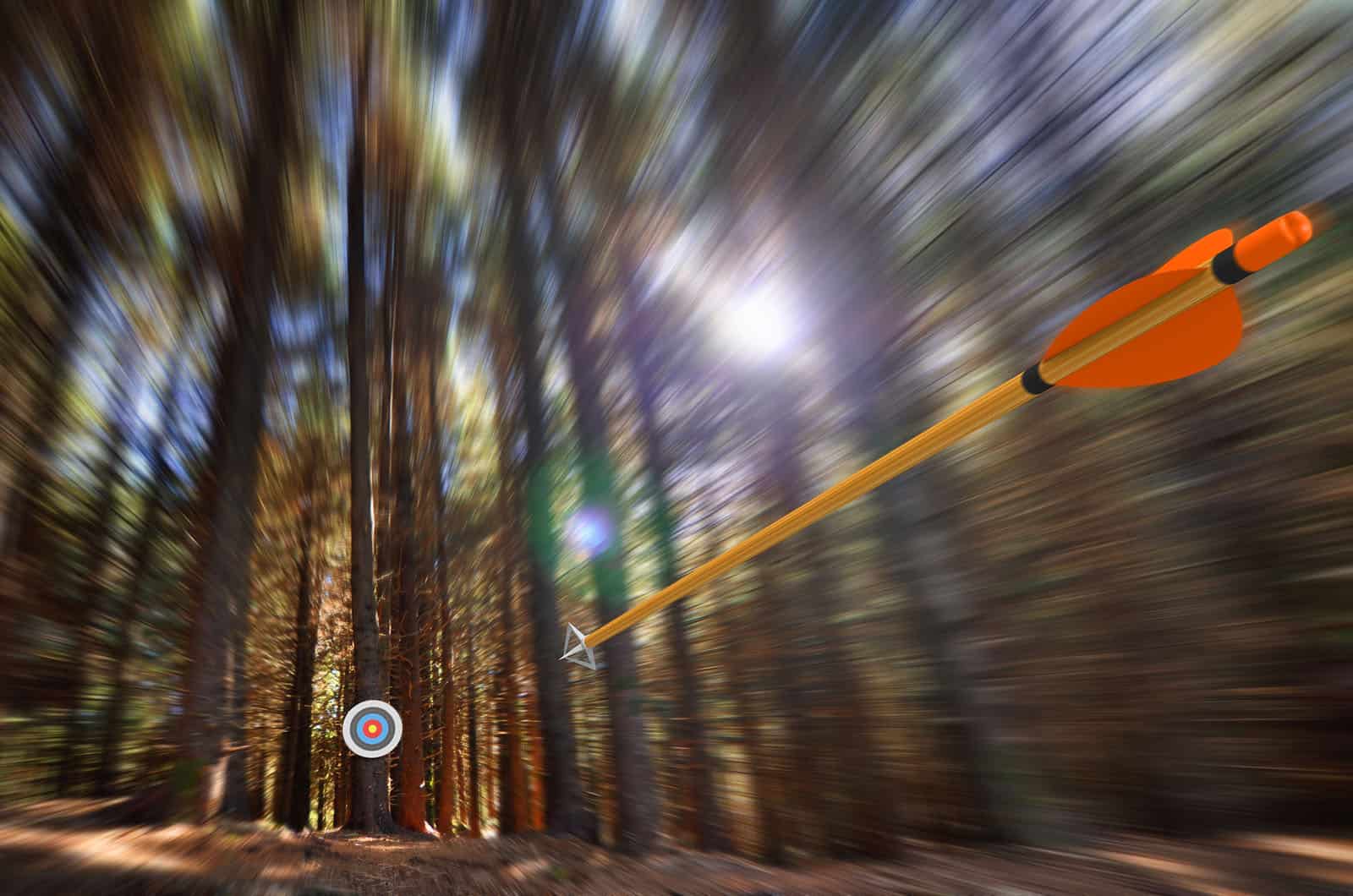
Arrow flying to target with radial motion blur


If you use a recurve bow, you are likely to get more energy and thus more arrow speed than a regular straight-limbed bow. However, the additional power is limited and extreme recurves can make the bow unstable. There is a definite relationship between recurve bow draw weight and draw length, and this is an important factor to be considered while optimizing bow efficiency.

We have discussed in detail about draw length. But what about draw weight? Draw weight is defined as the maximum weight that an archer may exert on the bow while drawing it, usually expressed in lbs.

The draw weight on a regular bow increases proportionally with the draw, so that the more you draw, the more is the draw weight. A recurve bow, however, behaves differently. Here, as you increase your draw, the pressure increases to a point, and then it drops by 20% to 30%.

Draw weight varies depending on the stature of the person, the governing factor to define size being gender and age of the shooter. You may find this simple chart useful in understanding the draw weight for people of different stature, based on age and gender:

Archer’s Weight Suggested Draw Weight
Small Children (70-100 lbs.) 10-15 lbs
Larger Children (100-130 lbs.) 15-25 lbs
Small-Frame Female (100-130 lbs.) 25-35 lbs
Medium-Frame Female (130-160 lbs) 25-35 lbs
Small-Frame Male (120-150 lbs) 30-45 lbs
Medium-Frame Male (150-180 lbs) 40-55 lbs
Large-Frame Females (160+ lbs) 30-45 lbs
Large Frame Men (180+ lbs) 45-60 lbs

Final Comments on Draw Length

So, now that we know the importance of draw length and have also learned how to measure draw length. Here are a few additional points that you would do well to keep in mind while dealing with this subject:

  • Personal Preferences: Each person is different from the other physically. When I say this, I allude to how personal preferences based on physical limitations come into play, where you may not be able to draw a full 30 inches. Then, you can go for a smaller draw length. Difficulty in pulling the bow to full draw can also come as a result of old injuries which are likely to restrict movement.
  • Clothing Factor: It may come as a surprise to you, but the clothing you wear can hamper your shooting, especially if you wear a jacket with big sleeves. Ensure that the sleeves of your clothes do not get in the way of your arrow, or else you may end up shooting your clothes.
  • ​Comfort Level: Although there are some very specific recommendations about the ideal draw length depending on the stature of a person, you need not be too rigid about the number that you get. If you feel more comfortable with a draw length that differs slightly from the measured figure, go for it.
  • ​D-Loop: It is interesting to note that the dimension of the D-loop (the component attached to the center of the bow string) has a bearing on the way you draw your bow. A shorter D-loop is likely to reduce ‘string pinch’ and helps in pulling the bow to full draw more comfortably.
  • ​Avoid Overdrawing: Last but not the least, always keep in mind that an overdrawn shot is never likely to be an accurate shot. If you feel that your accuracy is just a bit out of a particular draw length, reduce the draw length slightly which should help matters.

Conclusion​

We hope that you have enjoyed going through this tutorial and that you benefit from the information given here. For acquiring the best archery skills, it is important to know about your equipment, to gain absolute control over it. It is critical to know how to measure draw length because a lot depends on it for determining other vital factors like arrow length, draw weight and other parameters that can contribute to optimizing the accuracy and efficiency of your bow

If you liked reading this article, we would love to hear your comments and feedback, and we will be happy to respond to any questions that you may have. Please do remember to share this article, to enlighten others as well!

Filed Under: Hunting 20:12 by Kevin Steffey

How Long to Hang a Deer – Perfecting Aging: How to End Up With Perfect Venison

How Long to Hang a Deer – Perfecting Aging: How to End Up With Perfect Venison

One of the most common questions after a successful deer hunt is how long to hang a deer. It’s probably not the most common question for one simple reason: a lot of people figure it’s good to just chop them as soon as they’re done.

If you have the place for it, however, aging your venison a little bit can add a lot of flavor and smooth out the rough texture of the meat amazingly quick. There’s a few precautions you’ll want to take, but let’s get into how long you should actually leave them up there before you do the final butchering.

How Long to Hang a Deer ? The Short Answer: “It Depends”

That definitely sounds like a non-answer, but the truth is that figuring out how long to hang your deer will depend largely on where you are and what kind of facilities you have access to.

The following are all important factors to keep in mind when you bring your prize home or back to camp:

  • Temperature
  • Humidity
  • The Age of the Deer
  • What You Have Access To

The ideal temperature for hanging is between 35°F and 45°F. At this temperature the meat won’t begin to rot, but it also won’t freeze which will prevent aging from taking place.

You can actually replicate this temperature with a refrigerator that’s calibrated properly, but unless you have access to a walk-in you won’t be able to hang them.

That said, if you’re creative you can often find a way to manage to replicate the hanging process within a refrigerator:

If you’re lucky enough to be in an area where the temperature is proper, then your main concern will be to keep away other animals that might want a chunk of delicious venison.

How Long to Hang a Deer- Here Comes the Science!

Since there’s so many different factors coming into play, it helps to know a little bit of the science behind hanging venison for aging.

The main thing that you’re trying to accomplish is the aging of the meat, which brings out flavor and makes things more tender. This is why it’s important not to stick to a single “catch-all” answer for the length of time.

While aging has sometimes been described as “controlled rotting” by those who aren’t fans, that’s not strictly true. Rot is a process which occurs readily when bacteria are eating the meat, but by controlling the conditions the meat is in it can be avoided.

Instead, aging relies on natural mechanisms within the muscle that you’re planning on consuming to soften things up and concentrate the flavors since fluids are evaporating.

This is why a lot of novice hunters end up with tough venison, they simply butcher and freeze the animal’s flesh thinking that the process is done.

Instead, by hanging a deer or aging it in any other way you’ll end up with the delicious meat that most people associate with venison.

The culprit behind this toughness is a tissue called collagen. Younger animals will have less of it, which is why they’re so much more tender and you can get away with dry aging them for only a couple of days. Older animals will naturally have more, but the enzymes within the tissue will readily break it down if given time.

What does all of this mean? Well, firstly you should never butcher your deer before rigor mortis is over. Doing that will land you with thick chunks of meat that’s hard to chew and digest, proper aging only begins once the animal’s muscles have relaxed again.

Rigor mortis occurs between twelve and twenty four hours of the kill, so keep that in mind when you’re on the hunt.

Here Comes the Science!

The Optimal Timing for Amazing Meat

Now that we’ve overloaded you with information, let’s talk about a more practical way to get perfect meat.

Your deer will fare best if aged for at least a couple of days, and for younger animals a couple of days is fine. Obviously, if you’re not in a situation where you have access to a place of suitable temperature to hang your deer then you’ll have to make some concessions.

1. In these cases, butcher the animal as soon as rigor mortis ends. You can’t just hang your deer in bad conditions and hope it will age properly, wishful dreams do not make for exceptional meat.

2. For animals two years of age or under you want to hang them for two to three days. This allows adequate time for some aging to occur and since there’s less collagen present in the tissue you won’t receive as much benefit from allowing them to hang for longer although you certainly can if you prefer.

3. Older animals should hang for a week to two weeks. For this length of time, however, things can get a bit tricky if you don’t have access to a meat locker.

​

You need to make sure the temperature of the area your prize is in doesn’t get above 45°F for any considerable period of time and that it doesn’t drop below freezing. Try for at least four to five days, but don’t be afraid to butcher it after a day or two if the temperature is fluctuating.

Over two weeks and there’s not much real benefit to allowing things to go on for longer and it will quickly become detrimental to the quality of the meat.

Keep this in mind: hanging is the traditional way to age venison but most people haven’t found much of a difference in anything but skinning the deer.

If you don’t have access to a proper meat locker you can definitely just hang the deer until rigor mortis has ended, quarter them, and place them in a cooler of the appropriate temperature for the desired amount of time.

This is particularly a good idea if you have wildly fluctuating outside temperatures during the season you harvested in.

FURTHER READING➜ What Do Deer Eat In The Winter? What Do Deers Eat In The Winter ?

➜ Elk Hunting 101: 5 of the Best Elk Hunting Boots

➜ How to Cape a Deer – How To Cape A Deer For Mounting

➜ How Far Can A Bullet Travel? How Far Does A Bullet Travel

Conclusion

If you’ve been wondering how long to hang a deer, you’re now armed with the knowledge to end up with the perfect venison on your table after your next hunt. It doesn’t require much effort to get things done correctly and it can be the difference between the “boot leather” venison that people despise and some of the best meat in the world.

Any more questions? Comments on your favored methods? Let us know in the comments below.

Filed Under: Deer Hunting 07:02 by Kevin Steffey

  • « Previous Page
  • 1
  • …
  • 11
  • 12
  • 13
  • 14
  • 15
  • …
  • 44
  • Next Page »
  • Best Shooting Rest Reviews For A Perfect Hunting – Best Shooting Rests Reviews
  • Hunting Safety: 5 Best Treestand Safety Harnesses Reviewed
  • How Fast Can A Deer Run – How Hard Would It Be To Catch A Frightened Deer On The Run
  • Rice Bran for Deer- How to Effectively Use Rice Bran to Attract a Deer?
  • The Best Reloading Scale for Consistent Accuracy
  • Which Shotgun Choke Is The Most Open?
  • 17hmr vs 22lr: Which one Should You Use?
  • 5 Top Coyote Hunting Dogs That Are Proven To Be Tremendous Hunters
  • Best Shot Timer: Things to Know About the Top 10 Great Shot Timers
  • Elk Hunting 101: 5 of the Best Elk Hunting Boots

DMCA.com Protection Status

Deerhuntingfield.com is a participant in the Amazon.com Services LLC Associates Program, an affiliate advertising program designed to provide a means for sites to earn advertising fees by advertising and linking to Amazon.com. Additionally, deerhuntingfield.com participates in various other affiliate programs, and we sometimes get a commission through purchases made through our links.