Deer Hunting Field

Hunting Blog

  • Hunting
    • Best Coon Hunting Lights
    • Best Treestand Safety Harness
    • Best Hunting Boots
    • Best Rubber Hunting Boots
    • Best Muck Boots For Hunting
    • Best Treestand Safety Harness
    • Best Hunting Spotlights
    • Best Elk Hunting Boots
  • Archery
    • Best Arrow Rest
    • Best Bow Sights
    • Best Single Pin Bow Sight
  • Gun, Shooting & Accessories
    • Best Bipod for Long Range Shooting
    • Best Scope For Ar 10
    • Best Shooting Rest
    • Best AR 15 Bipod
    • Best AR 15 Slings
    • Best ACOG Clone
    • Best Shot Timers
    • Best Rifle Bipods
    • Best Shooting Tripods
  • Survival
    • Survival Shelter
    • Finding and Purifying Water in the Wilderness
  • About Us

The Top 5 Choices For The Best Deer Hunting Knife

The Top 5 Choices For The Best Deer Hunting Knife

Getting the best hunting knife would be a wise attempt for every recreational or serious hunter. If you ever found yourself in a circumstance that obliged you to own a good knife close by, would you be prepared for such? Consider the possibility that that specific circumstance had a thing to do with cutting some rope, dressing a deer or cleaning a fish.

Would you by any chance have a knife close by? Hunting is really a well-known game, that pulls in many every year, from everywhere throughout the world. It is likewise important to hunt for survival, else we would all have to befriend hunger (unless you are vegan). This implies that it is quite essential to have the best on the market.

In this article, we will take you through five of the best rated and most bought hunting knives available today. Each has its own special style yet they all have in like manner to be produced using the best material available, therefore making them both durable and long lasting.

Best  Deer Hunting Knife

Quality

Price

Our Rating

Buck Knife 0691BKG

B+

[amazon fields=”B000EHYZMI” value=”price”] Check It At Amazon.com

KA-BAR Fighting/Utility Serrated Edge Knife with Hard Sheath

A+

[amazon fields=”B000BSZDP8″ value=”price”]

Check It At Amazon.com

Outdoor Edge Razor-Lite Folding Hunting Knife

A-

[amazon fields=”B00CHSM2FE” value=”price”]

Check It At Amazon.com

Havalon Piranta Z Folding Blade Skinning Knife

B+

[amazon fields=”B00JYEBUPW” value=”price”]

Check It At Amazon.com

Buck Knives 124 Frontiersman Fixed Blade Knife

A+

[amazon fields=”B0081SRG2I” value=”price”]

Check It At Amazon.com

The Uses of a Hunting Knife

After hunting exercise, one should instantly gut (if you want to learn about How To Gut A Turkey click here) the deer or also known as field dressing while there is still heat in the body of the deer. If not, microorganisms can germinate on the lifeless body, and therefore render it uneatable. There are numerous hunting knives available and have diverse levels in pros and cons. Another name given to a deer hunting knife is a field dressing knife, and they possess a wide range of usage outside hunting of deer. In getting the meat of deer, you primarily utilize a knife to get the following done:

1. Gutting

The field dressing process is about gutting the inner organs of the hunted deer. A hunting knife that can penetrate through the skin is an absolute necessity in this process as it is the most imperative step in getting meat.

2. Skinning

When hunting deer to get their meat, you do not need the hide unless you need to make it into the fabric. This is another process in field dressing and aids the separation of the meat from its hide for easier usage.

3. Deboning

After the gutting and skinning process, getting the deer’s meat follows. In this process, the meat is being separated from the bones, and there is need to use a well-suited knife.

4. Butchering

This is the vital process when it comes to field dressing. It is the step where you slice up the meat to be preserved in your hunting bag. Just as the deer is pretty much overwhelming with its skin and bones, it is quite easier for you to focus on the meat.

Picking the Best Hunting Deer

We have already considered the various uses of a hunting knife. Here we will discuss what kind of knife to pick for deer hunting. Firstly, how about we make one thing off the beaten path here, which is the type of knife. Between a folding-blade knife and a fixed-blade knife, it can actually be said that obtaining a fixed-blade knife type would be the best option, not compromising on quality which could be a touch of an issue as regards to folding-blade knife types which comprise of moving features. With a full-tang, fixed-blade knife, you possess a great knife that suits the purpose.

Since we now know the various type of knife, we should proceed onward to the blade. A drop point blade type is what you would want to get, knowing that it is the best blade type that can deal with assignments, for example, skinning and field dressing of the hunted deer. Other types of blade, for example, tanto or clip point are not as proficient as the drop point blade type when it comes to deer hunting. There are various knives on the market that features a partially serrated edge and a drop point blade. If you incline toward serrated edges also, then partially serrated drop point knife types are probably the best you can ever purchase.

51p5caLNosL. SL1024

Via: Amazon.com

A blade that features a gut hook can involve preference. A gut hook can be quite easy to cut open the abdomen of the deer, in spite of the fact that the cons far exceed the pros, as they can frequently destroy the deer’s abdomen if not properly utilized, and don’t fill in as all-round, multi-use blades. The main issue when it comes to gut hooks is that they are extremely hard to sharpen. Truth be told, gut hooks can be a great deal harder to sharpen compared to serrated edge blades.

Since the sharp edge sort is dealt with, how about we discuss the metal construction of the blade. We need to go for a material that won’t rust and corrode easily. A high carbon steel concentration blade is a great choice to go for. There are blades with vanadium and chromium solution that prevent the blade against abrasion and corrosion.

Having taken care of the metal composition of the blade, we should proceed onward to the handle and sheath of the knife. The handle and sheath ought to have the capacity to withstand extraordinary climate conditions. For that, we require a handle that will be hard to slip. A sturdy rubber handle can take care of business, giving a nice grip. Concerning the sheath, you might need to pick a nylon or Kydex sheath. They are somewhat costlier than cowhide sheaths, however, they are worth their cost.

71UggXVARHL. SL1500

Via: Amazon.com

Since you now have a good understanding of what to consider, you can undoubtedly pick the best deer hunting knife. Therefore, a fixed-blade, drop point, full-tang knife is the types we recommend as regards to deer hunting. Hitting impeccable on quality, ease of use, and life span, you can’t turn out badly with a fixed-blade, drop point knife for hunting.

Best Deer Hunting Knife Reviews

We have made a review on the top 5 deer hunting knifes which we believe are appropriate for your use in this article. After long hours of extensive research, we finally came out with the list below. Make sure you pick the one that best suits your purpose. Here they are:

Best  Deer Hunting Knife

Quality

Price

Our Rating

Buck Knife 0691BKG

B+

[amazon fields=”B000EHYZMI” value=”price”] Check It At Amazon.com

KA-BAR Fighting/Utility Serrated Edge Knife with Hard Sheath

A+

[amazon fields=”B000BSZDP8″ value=”price”]

Check It At Amazon.com

Outdoor Edge Razor-Lite Folding Hunting Knife

A-

[amazon fields=”B00CHSM2FE” value=”price”]

Check It At Amazon.com

Havalon Piranta Z Folding Blade Skinning Knife

B+

[amazon fields=”B00JYEBUPW” value=”price”]

Check It At Amazon.com

Buck Knives 124 Frontiersman Fixed Blade Knife

A+

[amazon fields=”B0081SRG2I” value=”price”]

Check It At Amazon.com

#1 Buck Knife 0691BKG

If you have been a standard strategic knife handler or hunter, then you would without a doubt have encountered the Buck Knife in some discussion or the other. Buck Knives 0691BKG is a 4-1/8″ Drop Point knife manufactured and fabricated using 420 HC steel and designed to have a nice gut hook located at the tip of the full-bellied cutting edge.

The skinning game is made easy with this gut hook and will make your deer hunting go so smooth. You just have to simply put in the hook into the hide and afterward pull down thereby bringing about a seamless cut that won’t damage the ligaments. The edge has been held this while and despite the fact that on a heavier side at about 6.6 oz. It is still quite simple to handle.

You need to make sure your knife has a nice grip when it comes to bucking knife. The Buck Knife 0691 comes with a great texture drubber handle that is fabricated with a brass butt. This knife is also covered by the Buck Forever Lifetime Warranty and that is another great benefit attached to buying this knife

51gdbIwfKDL. SL1050

Via: Amazon.com

Check It At Amazon.com

Pros

  • The cutting edge is strong, sharp and durable for any purpose
  • Made of 420HC stainless steel
  • Can be used for tasks ranging from simple to heavy-duty applications
  • It is a multipurpose knife
  • The brand is covered by the Buck Forever Warranty scope
  • Not susceptible to corrosion

Cons

  • The sheath is dark nylon

[amazon box=”B000EHYZMI”]

#2 KA-BAR Fighting/Utility Serrated Edge Knife

This is also a heavy-duty multipurpose knife and is useful for hard activities like field dressing, skinning, kindling, and splitting. This is due to its strong and solid blade.

In addition, it is accompanied by a hard-shell dark nylon sheath produced using a glass-filled nylon sheath in order to keep the cutting edge securely tucked in the sheath and makes you not to worry about being accidentally cut by the knife when hunting. The glass-filled nylon sheath grip is adjustable and tight.

This knife has a drop-edge cutting edge which is sharp and solid and also features an angle of 20 degrees. Even after multiple usages, the sharpness of the cutting edge is still held intact and sharp as ever thereby showing that you don’t need to sharpen the edge Every time and it is of high quality.

61DAU7LuHwL. SL1500

Via: Amazon.com

Check It At Amazon.com

KA-BAR knife is heavy and big making it more proficient to be handle during mind blowing activities like chopping and wood hacking that demands extra weight to be applied. Therefore, you should consider buying this knife if you love intense hunting.

This knife also features an excellent grip and high durability. if any part of the knife got broken or damaged like the handle, you just have to remove the handle from the tang by loosening the bolt and replacing it. After that, you can continue to use your dearest knife again.

Note that the blade is 5inch and also ¼ inch thick which makes it difficult to use for intense applications like chopping

Pros

  • The cutting edge length of 5 inches and general length of 11.75 inches.
  • It weighs 295g thereby making it lightweight
  • It has finger protect to avert any form of cut or accident when it slips.
  • The serrated edge is useful for disjoining joints.
  • The sheath is made of Kydex.
  • KA-BAR’s have special Kraton handle material has a safe grip that won’t slip when wet.
  • It also has a lifetime guarantee.

Cons

  • Vulnerable to rusting if it is not taken care of

[amazon box=”B000BSZDP8″]

​

#3 Outdoor Edge Razor-Lite Folding Hunting Knife

This knife features 2 sharp edges/blades in 1 and is a kind of a hybrid between a fixed blade and a foldable knife. It is amazingly sharp and is below zero temperature and designed for better edge retention.

The Outdoor Edge knife has a blade of 3.6 inches in length while the general length of the blade is 8.3 inches in length. On the Rockwell scale, the hardness is 57-58 HRC. The gut hook, specifically, works astonishing great and you’ll have the capacity to open any little creature without breaking a sweat.

You should be watchful while swinging the edge because of its sharpness. There’s a little knob on the handle and a basic push of that will change the blade from a gutting equipment to a skinning one.

61YhEKOsWXL. SL1280

Via: Amazon.com

Check It At Amazon.com

Pros

  • Replaceable cutting edges don’t need to be sharpened every time.
  • Folds for simple conveying
  • Cut point sharp edge can be utilized for a wide range of applications
  • Push-button system makes changing sharp edges basic
  • Reasonable price

Cons

  • Sharp edge material is not intended to maintain its edge
  • Requires frequent changing of the blade
  • No warranty

[amazon box=”B00CHSM2FE”]

#4 Havalon Piranta Z Folding Blade Skinning Knife

This knife is just 6 inches in length when open and features an extremely thin grip. Its 4 3/8″ stainless steel edge is amazingly sharp and incorporates 5 simple on/simple off, fast change specifications, permitting users to accomplish more tasks than simply skinning, when they are making use of its blades outside.

Its cutting edges for replacement purpose are similarly as sharp, and features an orange ABS plastic handle which possesses nice grip, won’t rust, and is easily noticeable. It also comes with a lanyard opening, and a removable stainless steel clip which makes it simple and easier to be pocketed.

The blade is disposable and has a large length which makes it easy to dice and cut deer, with fewer swipes of the cutting edge.

31ZNQg3fyTL

Via: Amazon.com

Check It At Amazon.com

Pros

  • Portability
  • Foldable
  • Never Sharpen
  • It has a Sharp 60XT Blade
  • Elastic Sided Handle
  • 12 Blades Included
  • Surgical Precision

Cons

  • Sharp edge Change Procedure

[amazon box=”B00JYEBUPW”]

#5 Buck Knives 124 Frontiersman Fixed Blade Knife

This knife is 6.25 inches in length with a dark Micarta handle designed with an aluminum knob and aluminum protector that is accompanied by a leather sheath. This Buck brand will give you an excellent quality and cutting edge quality. Its brilliant resistance to corrosion makes it easy to be re-sharpen and has a very strong wear resistance functionality. This brand is also covered with a Buck Forever Warranty scope as they do not joke with the quality of their knife which is something that deserves an applause since not all brands provide a maximum lifetime warranty for their products

61hQ10VCRpL. SL1500

Via: Amazon.com

Check It At Amazon.com

Pros

  • It is a lightweight knife
  • Feature a Black Miata handle
  • It has a wide scope application
  • Extremely durable and simple to re-sharpen
  • The performance of the blade is magnificent as you can use it for various purposes.
  • The cutting edge is very sharp
  • Backed by Buck Forever Lifetime Warranty

Cons

  • Doesn’t perform well when chopping
  • It doesn’t have a rubber grip and can be dangerous

[amazon box=”B0081SRG2I”]

Conclusion

In conclusion, it will be to your own maximum benefit if you can pick the best deer hunting blade that is appropriate for your needs. More so, factors such as the type of sheath, stability, weight and blade designs are to be considered when choosing a knife.

From all the knives listed above, we are picking the KA-BAR fixed blade knife all because of few things we believe matters a lot. Its handle is well-fabricated with a good material and is exceptionally secure and totally have the tendency to avert any form of slip because of its finger protect and full-tang. For further suggestions or recommendation, leave us a comment below!

[amazon box=”B000BSZDP8″]

Filed Under: Hunting 02:22 by Kevin Steffey

13 Best Hunting Spotlights in 2022: Essential Gear Review for Hunters

13 Best Hunting Spotlights in 2022: Essential Gear Review for Hunters

No matter how skilled you are, night-time hunting is always trickier than daytime by orders of magnitude. Without proper gear and knowledge, it will be extremely difficult to take down anything in (often) complete darkness.

Plus, there’s also the problem of safety. Navigating in the dark is dangerous. It’s a lot easier to get lost when you can’t see where you’re going.

For all of these reasons, you must throw a good hunting spotlight to your night-time hunting kit. I have examined some of the best hunting spotlights that the market has to offer, ending up with 13 models. See if any suits your fancy!

In a hurry? This is our Winner!

TOP PICKIn a hurry? This is our Winner!9.8/10 Our ScoreGOODSMANN Rechargeable 4500 Lumen

  • High lighting performance
  • Durable
  • Waterproof
  • Easy and comfortable to use
  • Comes with a red light filter

Check Price On Amazon

Top Hunting Spotlight Comparison

Image Product Price Check Price
GOODSMANN Rechargeable Spotlight Waterproof Flashlight 4500 Lumen GOODSMANN Rechargeable Spotlight Waterproof Flashlight 4500 Lumen

$$$

Check Price
GOODSMANN Spotlight Hunting Camo Portable Handheld Light 1500 Lumen GOODSMANN Spotlight Hunting Camo Portable Handheld Light 1500 Lumen

$$

Check Price
LE Rechargeable LED Camping Lantern, 1000LM LE Rechargeable LED Camping Lantern, 1000LM

$$

Check Price
STANLEY FATMAX SL10LEDS Rechargeable 2200 Lumen STANLEY FATMAX SL10LEDS Rechargeable 2200 Lumen

$$

Check Price
DEWALT 20V MAX LED Work Light, Pivoting Head (DCL043) DEWALT 20V MAX LED Work Light, Pivoting Head (DCL043)

$$

Check Price
EverBrite LED Rechargeable Spotlight Flashlight 1000 Lumens EverBrite LED Rechargeable Spotlight Flashlight 1000 Lumens

$$

Check Price
BIGSUN Rechargeable Spotlight, High High Lumens 100000 LED Flashlight with Red Lens BIGSUN Rechargeable Spotlight, High High Lumens 100000 LED Flashlight with Red Lens

$$

Check Price
Rechargeable Spotlight Flashlight High Lumens, 90000 Lumen Rechargeable Spotlight Flashlight High Lumens, 90000 Lumen

$$

Check Price
GOODSMANN Realtree Xtra Cree Led Powerful 750 Lumen GOODSMANN Realtree Xtra Cree Led Powerful 750 Lumen

$$

Check Price
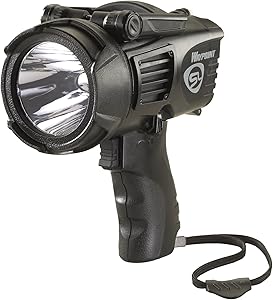
Streamlight 44905 Waypoint High Performance Pistol-Grip Spotlight Streamlight 44905 Waypoint High Performance Pistol-Grip Spotlight

$$

Check Price
GOODSMANN TACTICPRO Powerful 2000 Lumen HID Spotlight GOODSMANN TACTICPRO Powerful 2000 Lumen HID Spotlight

$$

Check Price
GOODSMANN Spotlight 6000 Lumen Boat Spotlight Waterproof Rechargeable GOODSMANN Spotlight 6000 Lumen Boat Spotlight Waterproof Rechargeable

$$$

Check Price
BUYSIGHT Rechargeable Spotlight,Spot Lights Hand held Large Flashlight 6000 lumens BUYSIGHT Rechargeable Spotlight,Spot Lights Hand held Large Flashlight 6000 lumens

$$

Check Price

The Best Hunting Spotlights in 2021

Lucky you, we’ve gone ahead and done the research and dug up five of the best spotlights that are currently on the market. While any of these will be suitable for most uses, picking just the right one can make all the difference for your final usage.

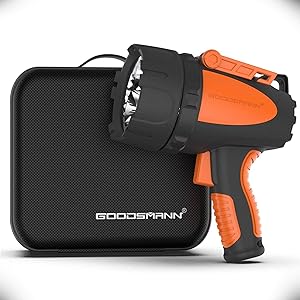
Best Spotlight for Hunting: GOODSMAN Waterproof Rechargeable Spotlight Flashlight 4500 Lumen

This GOODSMAN spotlight has a great combination between durability, ease of use, and lighting performance. Its balanced design easily makes it my top choice in this article. Though it is a little bit pricey, the spotlight has everything that you’d need to be successful at a hunt and more.

best hunting spotlight

Via: Amazon.com

The design is rugged. Its outer shell is made from impact-resistant ABS and the handgrip is padded with rubber for extra comfort.

Originally made for fishermen and sailors, the shell is completely watertight, giving it complete waterproofing ability. According to GOODSMANN, the spotlight will be fine when submerged in water up to 3.3 feet deep. A little bit of treading through swamp or being caught in the rain won’t bother it at all.

Aside from being waterproof, it is also dust-resistant.

In high power mode, the spotlight produces 6,000 lumens. Since the battery is a bit small, you will only get around 1 to 1.5 hours out of the spotlight in this mode. Use it sparingly.

There is a low power mode that decreases brightness, but improves battery life slightly. You can juice around 2 to 2.5 hours of battery life in this mode.

Last but not least, the emergency SOS mode brings the best battery life. You will get 8 to 9 hours easily on a full charge.

The light comes with a detachable red light filter. Place it on the front and the light will turn red, which is extremely helpful for a hunter.

Red light is excellent for hunting, especially if you’re hunting for varmint, predator, or even deer. Many animals are incapable of seeing red light. Thus, it makes target acquisition in the night a whole lot easier. Red light also enhances your natural night vision. It doesn’t dazzle like white light does.

As a result, this model fits the bill as one of the best spotlights for predator hunting.

What We Like

  • High lighting performance
  • Durable
  • Waterproof
  • Easy and comfortable to use
  • Comes with a red light filter

What We Didn’t Like

  • Pricey
  • Has only one lighting mode
  • Small battery

Best Runner Up Spotlight for Hunting: GOODSMANN Spotlight Hunting Camo Portable Handheld Light

From the very first look, it is obvious that this spotlight is made with hunters in mind. It is painted with Realtree Xtra camo pattern, allowing it to blend in with the surrounding as you stalk your prey. In addition, its performance is high and the spotlight is veritably durable.

best spotlights for hunting

Via: Amazon.com

Though it doesn’t boast any features aside from the basic lighting function, you will like it if you just want a pure spotlight to bring along with you on your hunt.

The outer shell is made from ABS impact-resistant plastic. As a result, it can be dropped, thrown, and bumped without suffering from any major damage. According to the manufacturer, the light is also water resistant. However, it is not waterproof (you shouldn’t soak it).

GOODSMANN painted the outer shell of the light with Realtree Xtra camo pattern. It is a very popular pattern that’s also used in many other hunter-centric products. Since it’s field-tested, rest assured that it will work for camouflaging purposes.

The GOODSMANN spotlight uses a halogen bulb that can generate 1,500 lumens. Its range goes as far as 2,000 feet. The halogen bulb is extremely useful for hunting since its color is naturally warm (reddish). Thus, it has a lower chance of startling animals.

Unfortunately, there is only one lighting mode. It’s either 1,500 lumens or zero. This makes the light quite inflexible as a result. But this doesn’t affect its standing as one of the best spotlights for hunting out there.

In order to make the spotlight easier to transport, GOODSMANN packaged it alongside an Oxford carrying bag.

Related: Best Hunting Tripods Reviews – Make the Perfect Shot with One of These Tripods

What We Like

  • Affordable
  • Good lighting performance with halogen bulb
  • Camouflaged
  • Durable
  • Easy and comfortable to use
  • Comes with an Oxford carrying case

What We Didn’t Like

  • Has only one lighting mode
  • Not waterproof

Best Budget Spotlight for Hunting: LE Rechargeable LED Camping Lantern

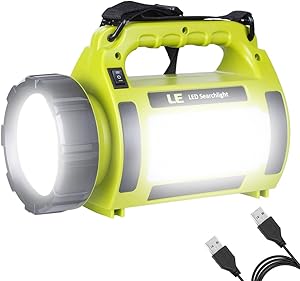
Though highly affordable, the LE rechargeable camping lantern is packed with features.

hunting spotlights reviews

Via: Amazon.com

Made from impact-resistant plastic, you can throw it around and abuse it however you want and it would hold up great. The light also has a water resistant rating of IPX4 (resistant against splashing water from all directions).

Now, on to the light itself. The LE lantern has three different light bulbs. One at the front and two on either side.

The front light has two illumination modes.

The high-power mode can reach a peak brightness of 1,000 lumens, giving you a range of around 660 feet. The light’s internal battery can sustain this mode for 2 hours. The low-power mode only reaches 400 lumens, but still gives you a range of 350 to 370 feet. In this lower power mode, you can get around 5 hours of battery life.

This bulb is best used as a spotlight for rescue or for night-time navigation.

The secondary light to the side also has two modes: high-power and low-power. On high-power, the light provides 130 lumens and can run for 6 hours. Throttling down to low-power, the lighting output is reduced to 75 lumens, but the battery can run it for up to 12 hours.

To the right of the lantern is a red light for emergencies and hunting.

Lastly, this lanter has a built-in 3,600 mAh power bank. Plug a USB cable in and you can recharge your phone, tablet, GPS, or other electronic gadgets.

What We Like

  • Highly affordable
  • Durable and splash-proof
  • Has several lighting functions
  • Large battery
  • Can be used as a power bank

What We Didn’t Like

  • Not waterproof

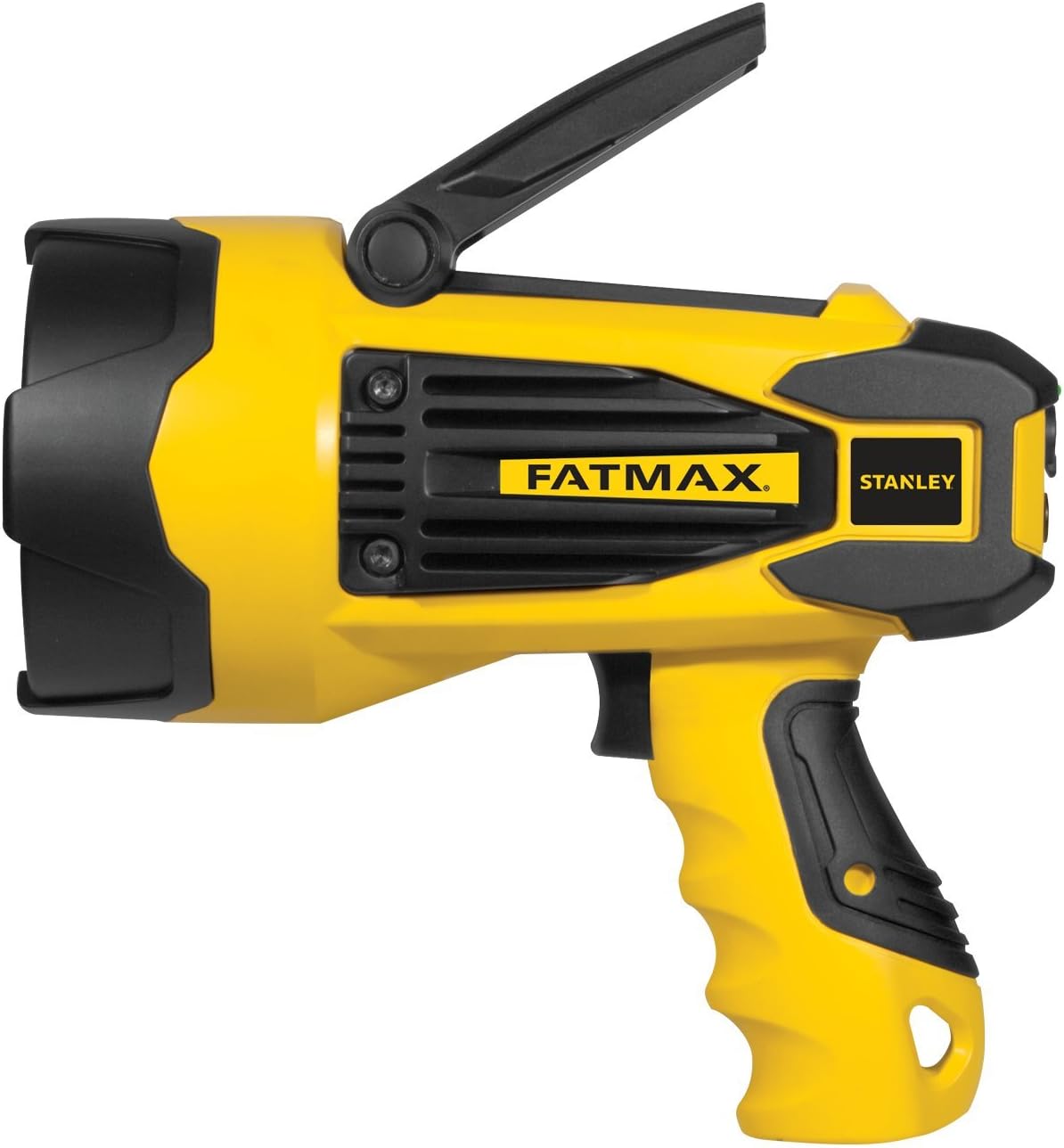
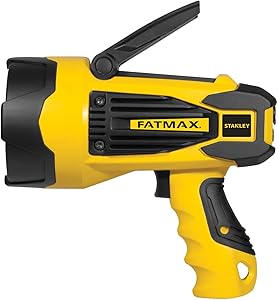
Best Handheld Spotlight for Hunting: STANLEY FATMAX SL10LEDS

The Fatmax series is one of the most popular best hunting spotlights for hunters. Bright, dependable, has plenty of features, while also being relatively affordable, it is a good model to consider if you want a value-packed spotlight for night hunting.

hunting spotlights

Via: Amazon.com

In terms of design, the Fatmax has a familiar pistol-style body. Though fairly compact and can be easily fitted into a backpack, it weighs 2 pounds. So, not exactly ideal if you like to travel light.

Other than this tiny hiccup, everything else about the design of the Fatmax is great. It is impact-resistant thanks to the use of hardy ABS plastic. Though it is not submersible, it can handle some light splashes onto the body and can handle being used in the rain.

The LED bulb can produce 2,200 lumens at the highest setting. Unfortunately, the battery can only sustain this brightness for around 1 hour.

If you need better energy efficiency, you have to defer to the low power mode. The light only produces 930 lumens then, but battery life can be as high as 7 hours.

The light itself only contains a white LED chip. If you want red light, the Fatmax comes with an emergency red lens that can be attached to the front of the spotlight.

Other than serving as a hunting LED spotlight, it can also be used as a power bank. There is a USB port at the back for you to plug in your electronics.

What We Like

  • Affordable
  • Durable and splash-proof
  • Has a red light filter
  • Can be used as a power bank

What We Didn’t Like

  • Not waterproof
  • A bit heavy
  • Small battery

Best Spotlight for Deer Hunting: DeWalt 20V MAX LED (DCL043)

If you need something compact and light, try the DeWalt DCL043.

Its 1-pound weight and compact dimensions make transportation and storage simple. The DeWalt spotlight for hunting — according to my tests — is tough and lighting performance is as high as advertised, which is to be expected from a brand as well-known as DeWalt.

rechargeable spotlight for hunting

Via: Amazon.com

The selling feature of this light is its compact size. If you like to travel light, this handheld spotlight will be a fine choice. It weighs around 1 pound and can easily fit inside of a hiking backpack (11.13 x 4.75 x 14 inches).

The head of the light can be swivelled up to 90°. The base of the light is also quite wide, allowing it to stand on its own. As such, it can be used as a stationery light when you set camp.

The spotlight is built from impact-resistant plastic. Though I didn’t test its durability in detail, I’m certain that you can treat it roughly and it won’t be very bothered. After all, DeWalt’s products have a reputation for being hardy.

One small thing that I don’t like is that it is only rated for IP54 (dust resistant). It is not water resistant. So, if you hunt somewhere with plenty of rain, you may run into troubles with this spotlight.

The spotlight uses four different LED bulbs. Three white lights are used for the main illumination mode. The fourth one is a red light.

Using the high-power mode, the three LED bulbs can produce 1,500 lumens, allowing you to see as far as 1,500 feet. The battery lasts around 4 hours in this mode.

If you want to conserve battery, you can use the low-power mode. It only produces 500 lumens but in return, you get a stronger battery life at around 13 – 13.5 hours.

The red light setting is a lot less bright at only 90 lumens. However, it doesn’t need to be bright. For hunting, a red light that’s too bright will only scare preys away. And if you want to preserve your night vision, a low-power red light like this works best. For this reason, I also picked this model as my best spotlight for deer hunting.

What We Like

  • Compact and lightweight
  • Durable and dust-resistant
  • Multiple illumination modes
  • Has a separate red LED bulb for producing red lighting

What We Didn’t Like

  • Isn’t rated for water resistance

Best Rechargeable Spotlight for Hunting: EverBrite Rechargeable LED Spotlight

Though having several power modes is useful, it is not as useful as being able to flexibly dim and brighten the light at will. The selling point of this EverBrite spotlight is exactly that: you can control exactly how bright you want the light to be.

Best Dimmable Spotlight for Hunting

Via: Amazon.com

But first, as always, let’s talk about design. It is rugged and made from strong, impact-resistant ABS plastic. One design feature that I particularly like is the shock-absorbing rubber bumper at the front. It protects the light in case the spotlight ever falls on its head.

It is IPX4-rated and can withstand some light rain and splashes. Not submersible, though.

The light is a CREE LED chip and has a peak brightness of 1,000 lumens. But, through the use of two “UP” and “DOWN” buttons at the back of the light, you can dim or brighten the light to whichever level that you want. It makes this light a lot more flexible than others in this list.

You can approach a deer from afar and gradually dim down the light as you get closer to make it less likely to spot you. Thus, it is probably the best spotlight for shining deer here.

Though it is not capable of producing red light on its own, the EverBrite comes with a red lens. It makes it one of the best spotlights for coyote hunting out there.

In the box is a conventional USB cord for charging. There is also a cigarette lighter charger for juicing up in the car.

What We Like

  • Relatively affordable
  • Rugged design
  • IPX-4 rated
  • Dimmable lighting
  • Has a red lens

What We Didn’t Like

  • Not submersible

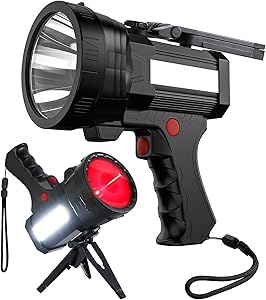
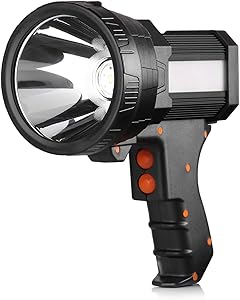
Best Emergency Spotlight for Hunting: BIGSUN Rechargeable Spotlight

A spotlight isn’t just used to spot animals in the night. It’s also immensely handy during emergencies while you’re hunting. For example, if you got lost or someone in your crew got lost in the night, proper lighting is extremely important. It’ll be easier to navigate, search, or signal for rescue.

Best Emergency Spotlight for Hunting

Via: Amazon.com

In this respect, the BIGSUN spotlight is worth investigating as the best spotlight flashlight.

The light weighs 1.12 pounds, which is light enough to not bog you down while you’re on the move. It can be fitted into a travelling backpack easily and deployed whenever you need. It comes with a shoulder strap for better ease of use.

The light comes with a durable plastic shell. It feels a little cheap, but so far, it has held up well. I dropped it and threw it around and there wasn’t any damage at all.

It has a dust-proof IP45 rating, but there doesn’t seem to be a rating for water resistance. This is a pretty great disappointment. So, if you choose this model, I recommend packing it up in a waterproof case.

There are two kinds of lights on the BIGSUN: a primary spotlight and a side flood light.

The spotlight at the front has a peak brightness of around 6,000 lumens, capable of illuminating objects as far out as 2,600 feet. The high illumination power is extremely useful for when you’re searching for a missing person.

Like many other spotlights, there is a low-power mode that reduces the output for better battery life. This is the preferred mode for navigating.

The spotlight also has an strobe mode for SOS calls.

The flood light to the side has lower lighting power than the frontal spotlight, but nonetheless, it is helpful for when you settle down and make camp. The broad lighting angle can shine more uniformly across an area.

It has a high-power mode and a low-power mode. But, more importantly, it has an emergency mode, too. When in use, the light will flash red and blue to signal for help.

The light doesn’t have a dedicated red LED bulb, but it has a red filter.

You can take advantage of the high-capacity Li-ion battery (10,800 mAh) to charge your electronic devices. There is a USB port on the light.

What We Like

  • Durable design
  • Lightweight and compact
  • IP45 rated (dust-proof)
  • Strong lighting performance
  • Two lights: a spotlight and a floodlight
  • Has emergency lighting modes
  • Comes with a red light filter

What We Didn’t Like

  • Doesn’t have water resistance rating
  • Feels a bit cheap due to the plastic material

Best Brightest Spotlight for Hunting: BERCOL Rechargeable Spotlight, 90000 Lumens

If you need extremely strong lighting performance, take the BERCOL rechargeable spotlight out for a whirl.

Best High Power Spotlight for Hunting

Via: Amazon.com

Although it was initially advertised as having a 90,000 lumens brightness, I only measured about 9,000 lumens. The advertisement may be faulty, but the product itself is decent enough. It is brighter than most spotlights that I had tested out thus far and can easily fit as the brightest hunting spotlight on this list.

Design-wise, the BERCOL spotlight is unremarkable. It has a fairly cheap feeling body and doesn’t look rugged at all. Because of this, I recommend that you exercise caution when you use it and don’t drop it.

While it doesn’t look like it’s impact-resistant, it is water-resistant. The light is IPX5-rated, so it can handle heavy water splashes and rain with no problem.

The light weighs 1.5 pounds. Though the back portion of the light is narrow, the conical housing at the front is very wide. It won’t be easy fitting the light into a backpack, so you should carry it separately.

A super bright LED chip is housed inside of the conical housing at the front. Despite the initial claim of it being 90,000 lumens, it’s actually not that bright. Around 9,000 lumens is my estimate. This is still plenty bright and can light up an area that’s well beyond 2,000 feet. It is the brightest spotlight for hunting on the list.

The light uses an 8,000 mAh Lithium-ion battery. It can sustain the light at the highest brightness setting for around 4 hours.

You also have three other modes that you can use: medium power, low power, and an emergency strobe mode. The less bright it is, the more power you can get. At the lowest power setting, I recorded about 7 hours of use.

You can also use the light as a power bank for your electronic devices, too. A USB port is available to the side of the body.

What We Like

  • Relatively affordable
  • IPX5-5 rated
  • Extremely strong lighting performance
  • Has multiple illumination modes
  • Can be used as a portable power bank

What We Didn’t Like

  • Flimsy design
  • Lighting performance isn’t as high as advertised

Best Intermediate Power Spotlight for Hunting: GOODSMANN Realtree Xtra, 750 Lumen

Between a low-power light like the Streamlight 44905 and more powerful best hunting spotlights, there are spotlights like GOODSMANN Realtree Xtra, 750 Lumen. Like its name suggests, the bulb only goes up to 750 lumens. In my opinion, this strikes a good balance between light performance and battery efficiency.

Best Intermediate Power Spotlight for Hunting

Via: Amazon.com

On the outside, this model looks exactly the same as the camouflaged GOODSMANN spotlight. Coated in Realtree Xtra camouflage pattern, it seamlessly blends with the surrounding wilderness and makes you more difficult to detect from afar. The light is built with impact-resistant plastic and shock-absorbing rubber parts, resulting in excellent durability.

The light is water resistant, but it is not submersible led spotlight.

Weighing 1.3 pounds, it is decently light. The dimensions of the spotlight are also compact enough that you won’t have any trouble carrying it around.

This GOODSMANN spotlight uses a CREE LED chip with a peak brightness of 750 lumens. The beam distance measures around 1470 to 1480 feet. Due to the lower peak brightness, battery life is a lot better. You can get about 10 hours or more, depending how often you use the light.

It doesn’t offer you the ability to change the brightness. ON or OFF is all you get. The limitation is quite disappointing and curtails the usefulness of the light significantly.

As expected, it doesn’t come with a built-in red LED light. If you need colored light, you will have to buy and use color filters.

What We Like

  • Camouflaged
  • Decently compact and lightweight
  • Battery efficient
  • Has a red light filter

What We Didn’t Like

  • Not submersible
  • Only one lighting mode

Best Low Power Spotlight for Hunting: Streamlight 44905 Waypoint

Brightness isn’t always a priority. Sometimes, you want a dependable spotlight that can run for a long time on a single charge while providing merely adequate lighting. For that purpose, the Streamlight 44905 Waypoint can satisfy.

best handheld spotlight for hunting

Via: Amazon.com

There’s not much to talk about design-wise. Like other outdoor spotlights, the Streamlight 44905 is made from impact-resistant plastic. Thus, it can handle some rough usage without breaking.

The Streamlight 44905 is weatherproof and has an IPX4 rating. It can handle some light splashes and some rain. However, it is not submersible.

As for lighting performance, unlike other models which usually go well beyond 1,000 lumens, this model only goes up to 550 lumens on the highest power setting. In return, it enjoys a decent battery life of 10 hours, which makes this the best rechargeable spotlight for hunting on the list!

The light will still be bright enough for night-time navigation and long-distance target finding. Its beam has a range of well over 2,000 feet.

It has a low power mode, which provides about 40 lumens. It is suitable for night-time navigation or for providing lighting to a campground. Battery life in this mode is quite impressive: 82 hours continuously.

A third mode is also available: emergency illumination. It is just a strobe light mode for you to signal rescue. This mode uses only 40 lumens to conserve battery life.

The light doesn’t come with a color LED bulb or filters. If you want to cast green or red light for easier night-time hunting, you can find color filters being sold separately on the manufacturer’s website.

Streamlight 44905 comes with a 12V cord. If you’re close to your car, you can plug the light in and use the car’s battery for power. It’ll give you near-unlimited lighting.

What We Like

  • Affordable
  • Rugged design with IPX4 rating
  • Extremely long-lasting due to low lighting modes
  • Has emergency lighting mode

What We Didn’t Like

  • Lighting performance is unimpressive
  • Doesn’t come with color filters

Best Search Spotlight for Hunting: GOODSMANN TACTICPRO 2,000 Lumen

Searching — whether for someone or for a prey — will require a focus-beam, high-power spotlight. That’s exactly what the GOODSMANN TACTICPRO spotlight offers.

best rechargeable spotlight for hunting

Via: Amazon.com

The design itself is very simple and, unfortunately, not very rugged. Yes, it is made from ABS plastic, but the design feels a little bit flimsy. It doesn’t feel like it would survive being roughly treated.

This spotlight, unlike others, does not have a battery. You will need to plug it to a power source like a car or a portable power bank. The light comes with an 8-foot coiled cord with a 12-volt DC plug.

Lighting performance is where this spotlight literally shines, though. With its 35-watt High-Intensity Discharge (HID) lamp, it can produce an intense beam of light that measures 2,000 lumens.

However, note that the xenon spotlight needs some time to brighten. After it’s turned on, it will gradually brighten until it reaches its peak brightness. In my test, it takes about a minute.

The light is designed to form a focused beam, so its range can be as far out as 2,780 feet. This makes spotting people or animals from afar easier, making this my recommendation for the best spotlight for long distance hunting.

What We Like

  • Very good lighting performance with HID bulb
  • Great lighting range (2,780 feet)

What We Didn’t Like

  • Flimsy design
  • Has to be plugged in

Best Waterproof Spotlight for Hunting: GOODSMANN Spotlight 6000 Lumen Boat Spotlight

If you need a hunting spotlight that’s waterproof, this GOODSMANN performs just as good as my top pick.

The spotlight is built for toughness. Most of its body is cast from impact-resistant ABS plastic. But, to strengthen the frame, some sensitive parts are made from aluminum. It can definitely stand up to the rigors of the hunting trail.

spotlights for hunting at night

Via: Amazon.com

Like I said earlier, this GOODSMANN spotlight is waterproof, too. So, you can bring it with you even to the wettest of environments and it will still hold up fine.

Its pistol-style grip is made from rubber. The grippy material will prevent the spotlight from slipping out of your hand when it’s wet while also improving comfort.

Lighting comes from three CREE LED chips which, together, provide about 4,500 lumens in the high-power lighting mode. It can illuminate anything in a massive range of 1,500 feet. It is easily one of the best hunting spotlights out there for long-distance target spotting.

The light will be less intense in low-power mode. Battery life is obviously going to be better, too.

Unfortunately, the drawback of this light is its battery. The battery lasts only 2-3 hours on high-power and 4-5 hours on low-power. Compared to many models on the market, this is quite low. Make sure to keep the spotlight close to a charger just in case.

What We Like

  • Waterproof
  • Durable design
  • Comfortable to use
  • Great lighting performance
  • Has a low power mode

What We Didn’t Like

  • The battery’s capacity is small

Best Impact-Resistant Spotlight for Hunting: BUYSIGHT Rechargeable Hunting Spotlight, 6000 Lumens, Aluminum Alloy

As an alternative to the GOODSMANN marine spotlight’s waterproofing ability, if it is an impact-resistant spotlight that you need, consider the BUYSIGHT spotlight, instead.

handheld hunting spotlight

Via: Amazon.com

Its key selling point is its aluminum alloy body, which is a lot more durable than all the other lamps in this series that are made from ABS plastic. The body is bolted in place using copper screws. As a result, this light will be able to withstand tougher falls than other best LED spotlights for hunting.

Other parts of the light are built for durability, too. At the front is a rubber bumper that protects a shatter-resistant glass piece covering the LED housing.

For such a rugged spotlight, the fact that it weighs only around 1.7 pounds is quite surprising. It’s still very portable.

All in all, if you expect that you’d go through some pretty tough trials on the road, the BUYSIGHT’s tough design will give you peace of mind.

The primary LED bulb at the front has a peak brightness of 6,000 lumens on paper. A fully-charged battery can last for around 10 hours in this mode.

However, my estimation shows that the light isn’t as bright as 6,000 lumens. Around 3,000 or 4,000 lumens would be my guess. I have compared it with some other spotlights and it falls in line with the results I got from a few 3,000 – 4,000 lumens models.

Aside from the high power mode, you also get a low power mode, which extends battery life to well beyond 24 hours.

There are two other lights to the side.

One is a white flood light. It’s not as bright as the primary light, but it has a broader illumination angle suitable for lighting up a campsite. This one has two illumination modes. On high-power, it lasts around 20 hours and 40 hours on low-power.

The other side has a red-and-blue emergency light. You can use it as an emergency signal. Battery lasts around 30 hours with this light on.

There is a USB port at the back of the light that you can use to plug in your electronics. They will draw power from the light’s battery, essentially turning it into a portable battery bank.

It doesn’t have a red light, but you can use a color filter. An interesting accessory that this light comes with is an EVA carrying case.

What We Like

  • Extremely durable metal body design
  • Portable
  • Has multiple lights
  • Powerful lighting
  • Strong battery life
  • Can be used as a power bank
  • Has a red light filter and an EVA carrying case

What We Didn’t Like

  • Isn’t as bright as advertised

Legality of Spotlighting

In many states, it is illegal to spotlight deer from a moving vehicle. In some states, it is also illegal to spotlight deer from a stationary vehicle. It is always best to check with your state’s wildlife department to find out the specific laws in your area before you go hunting.If you are caught spotlighting deer in a state where it is illegal, you could be fined and/or lose your hunting privileges. So, it is important to know the law and obey it.Spotlighting can be a great way to see wildlife at night. But, it is important to use caution and follow the law when using a spotlight for hunting purposes.

Keep in mind that for the most part spotlighting animals while in possession of a firearm is a crime, even if you don’t take the shot. In fact, in many places it’s illegal regardless of when you’re planning on doing it.

At the very least you’ll get a fine, but if they can prove you were poaching you may be looking at a more serious offense. Know your local laws when you use one to avoid trouble.

For the most part, these regulations apply only to the lawful hunting of deer, however, and spotlights are sometimes used when it comes to the lawful killing of pest animals.

Related: Where To Shoot A Deer – Top 5 Best Places To Shoot A Deer

Of course, most of us don’t have any nefarious intentions when we decide to go out and spotlight some animals.

It’s a fun way to observe night wildlife that you would otherwise never get a chance to see, and it can even be a completely valid method of scouting an area in the off-season if you keep track of your data.

So be safe, be legal, and pick the best one you can.

Choosing a Best Spotlights For Hunting

There’s a few different things that can be combined to make a great spotlight. By keeping them in mind, you can make sure that you end up with the best possible light for what you’re planning on doing.

#1- Power

The power of a light is measured in Lumens. Unfortunately, this doesn’t always give you a total reflection of the power of a spotlight. This is because the reflectors make a huge amount of difference and Lumens are only used for the total power output of the bulb.

Further complicating matters, spotlights use a slightly different rating system than house lights which makes it even more troublesome to judge the light.

As a general rule of thumb 100 Lumens is okay, 200-400 Lumens is pretty ideal for spotting, and 500+ is a super bright light.

brightest spotlight for hunting

#2- Power Source

The power source is another important consideration. While any spotlight suitable for hunting is likely to be battery powered, most of us will want a car charger for the sake of convenience. A 12V adapter can be charged in the field, and some lights can even be run straight from the lighter in the console which is good if you want to remain in the vehicle.

➜ RELATED:The Best Ar 15 Bipod Reviews Today That Will Improve Your Hunting Skills

#3- Bulb Type

The type of bulb used to be a point of contention, but it’s not really much of a thing anymore. LEDs are simply superior to halogens since they run cooler, last for an obscene amount of time, and are generally brighter while taking less power.

Anything that we recommend is going to have a LED bulb for that reason, but if you come across an old halogen spotlight you really might want to consider making the upgrade.

#4- Durability

Build quality is another quality which makes for a great hunting spotlight. If you don’t really have a well-built light then it’s not going to do you much good if you drop it while in the field. Most should hold together for a couple of drops, but something which can land on a rock and emerge unscathed is ideal.

#5- Colored Lenses or Filters

Build quality is another quality which makes for a great hunting spotlight. If you don’t really have a well-built light then it’s not going to do you much good if you drop it while in the field. Most should hold together for a couple of drops, but something which can land on a rock and emerge unscathed is ideal.

Color filters are great for specialized usage, and you might want to consider them when you’re picking a spotlight to use. They’re particularly useful for predator hunting which is allowed in quite a few areas.

Red lights will allow you to preserve more of your natural vision and doesn’t scare animals quite as easily as white or green lights will. Many hunters find that red lights are a great idea, but they don’t show as much detail as green or white lights will and so you’ll have to be double sure of your target. You don’t want to mistake a dog for a coyote after all.

Green is brighter and will generally show darker animals easier. They’re used by a lot of hog hunters for that reason, and feral pigs seem to be less sensitive to green light than a lot of other animals.

The standard white light can be used for hunting purposes as well, but it’s often best to utilize a softer light to illuminate one area than it is to shine a super bright spotlight suddenly. Deer will freeze up when spotlighted in this fashion, but it’s illegal to hunt them with a spotlight and most animals will bolt if the lighting comes in too suddenly.

#6- Ergonomics

While it’s not quite as important if you’re planning on spotting from your car or truck, how the light feels in your hand can make a big difference if you’re night hiking and want to see some wildlife.

Look for rubberized grips and molding for your fingers, as well as a natural angle from the top of the hand to the light that you think you’ll be comfortable with.

The weight of the light will also factor in here, especially if you’re planning on carrying it all night and not stowing it in a pack until you get to the desired area.

#7- Cost

Cost is always a factor in any kind of equipment. With spotlights there can be quite a bit of variation, as some brands of equipment tend to sell themselves by name. This means that you can sometimes find a superior light at a lower price if you’re careful.

The truth is, however, that as long as the light has everything else you want then a lot of times the more expensive brands will be the winner at the end of the night.

There are many different factors to consider when choosing the best spotlights for hunting. The most important thing is to find a light that is bright enough to help you see your target in low light conditions. You also need to find a light that is durable and reliable, so that you can count on it to work when you need it most.Another important factor to consider is the size and weight of the light. You want to choose a light that is easy to carry with you on your hunting trips. And finally, you should consider the cost of the light. You want to find a light that fits within your budget without sacrificing quality or performance.

When using a spotlight for hunting, be sure to:

– Choose a light that is bright enough to help you see your target in low light conditions.

– Choose a light that is durable and reliable.

– Choose a light that is easy to carry with you on your hunting trips.

– Follow the law in your state regarding the use of spotlights for hunting purposes.

Benefit of spotlight for hunting:

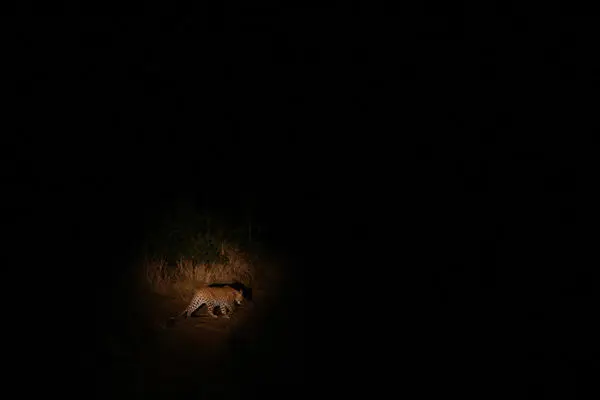
Spotlighting can be a great way to see wildlife at night. By using a spotlight, you can observe animals that you would otherwise never get a chance to see. Additionally, spotlighting can be a valid method of scouting an area in the off-season. Just be sure to follow the law in your state when using a spotlight for hunting purposes.

Conclusion

Having the best hunting spotlights with you is a major game-changer in the night, especially if you haven’t upgraded to night vision or thermal scopes yet. But even more so, a spotlight will keep you and your fellow hunters safe if you were to ever get lost at night!

My top pick for this article is the GOODSMANN marine spotlight. Pricey, but it has all of the important features that a hunter would ever want out of a spotlight.

It is extremely durable thanks to its impact-resistant and waterproof shell. Waterproofing isn’t something that many hunting spotlights do well, so this model stands out clearly from the rest. The light does all this while maintaining a fairly lightweight and compact body.

Battery life, despite being mediocre, is acceptable. Lighting performance is great enough for most hunters (4,500 lumens) and if you ever need colored light, a red filter is available.

Frequently Asked Questions

Red vs. Green Light: Which Is Better?

For big game (deer, moose, elk), varmint, and predators, a red light is best. They do not have red-registering light cones in their eyes, so they are incapable of seeing the color red.

Red vs. Green Light: Which Is Better

Red light, coyote hunting dogs, and the best coyote baits will make taking out these varmints very easy.

But if you’re going hog hunting, green light is best. Their eyes are less capable of registering green than white or red.

Just make sure that the light that you use isn’t too bright. Even if they cannot recognize the color, if the light is bright enough, they would run away all the same.

LED vs. HID vs. Halogen: Which is Better for Hunting?

Most hunting spotlights have LED (Light-Emitting Diode) bulbs as they last very long and cost less. Performance is also good enough with LEDs, case example being those best Q Beam spotlights. They could be as bright as 10,000 lumens.

But, in terms of energy efficiency or brightness, LEDs cannot compare with HID (High-Intensity Discharge) light. These can burn brighter, but consume less power than LEDs. Unfortunately, they don’t last very long.

For hunting, though, I prefer halogen lamps.

Halogen lights are warmer in temperature (redder). Like I said, animals have difficulties registering reddish lights. As a result, halogen bulbs are less likely to startle the animals than the bright white beam of LED or HID bulbs.

best handheld spotlight for hunting

What Are the Differences Between Candela and Lumen?

Brightness can be measured in one of two ways: in candela or lumen.

Candela is a measurement unit that describes how intense the light is. The higher the candela, the farther you can be from a target and still see it clearly.

On the other hand, lumen is the standard measurement for brightness. It is the more popular out of the two. It measures the brightness from any point in the direction away from the light.

best rechargeable spotlight for hunting

You’ll find more use out of lumen and most manufacturers will give you this number. Candela is still used by many out there. In that case, just convert the candela to lumen if you want to know exactly how bright it is in the standard measurement. 1 candela = 12.57 lumens.

[tcb-script type=”application/ld+json”]{ “@context”: “https://schema.org”, “@type”: “FAQPage”, “mainEntity”: [{ “@type”: “Question”, “name”: “Red vs. Green Light: Which Is Better?”, “acceptedAnswer”: { “@type”: “Answer”, “text”: “For big game (deer, moose, elk), varmint, and predators, a red light is best. They do not have red-registering light cones in their eyes, so they are incapable of seeing the color red.Red light, coyote hunting dogs, and the best coyote baits will make taking out these varmints very easy.But if you’re going hog hunting, green light is best. Their eyes are less capable of registering green than white or red.Just make sure that the light that you use isn’t too bright. Even if they cannot recognize the color, if the light is bright enough, they would run away all the same.” } },{ “@type”: “Question”, “name”: “LED vs. HID vs. Halogen: Which is Better for Hunting?”, “acceptedAnswer”: { “@type”: “Answer”, “text”: “Most hunting spotlights have LED (Light-Emitting Diode) bulbs as they last very long and cost less. Performance is also good enough with LEDs, case example being those best Q Beam spotlights. They could be as bright as 10,000 lumens.But, in terms of energy efficiency or brightness, LEDs cannot compare with HID (High-Intensity Discharge) light. These can burn brighter, but consume less power than LEDs. Unfortunately, they don’t last very long.For hunting, though, I prefer halogen lamps.Halogen lights are warmer in temperature (redder). Like I said, animals have difficulties registering reddish lights. As a result, halogen bulbs are less likely to startle the animals than the bright white beam of LED or HID bulbs” } },{ “@type”: “Question”, “name”: “What Are the Differences Between Candela and Lumen?”, “acceptedAnswer”: { “@type”: “Answer”, “text”: “Brightness can be measured in one of two ways: in candela or lumen.Candela is a measurement unit that describes how intense the light is. The higher the candela, the farther you can be from a target and still see it clearly.On the other hand, lumen is the standard measurement for brightness. It is the more popular out of the two. It measures the brightness from any point in the direction away from the light.You’ll find more use out of lumen and most manufacturers will give you this number. Candela is still used by many out there. In that case, just convert the candela to lumen if you want to know exactly how bright it is in the standard measurement. 1 candela = 12.57 lumens.” } }]}[/tcb-script][tcb-script type=”application/ld+json”]{ “@context”: “https://schema.org/”, “@type”: “CreativeWorkSeries”, “name”: “13 Best Hunting Spotlights in 2021: Essential Gear Review for Hunters”, “aggregateRating”: { “@type”: “AggregateRating”, “ratingValue”: “5”, “bestRating”: “5”, “ratingCount”: “6” }}[/tcb-script]

Filed Under: Hunting Gear & Accessories 01:02 by Kevin Steffey

Everything You Ever Wanted to Know About Turkey Hunting

Everything You Ever Wanted to Know About Turkey Hunting

Turkey are one of the most commonly sought after game animals in America. It’s easy to see why, they have the rare distinction of giving both fantastic sport and making a delicious meal once you’ve tagged one. If you’re planning on going turkey hunting and haven’t been out before, then read on, you’re in for a treat.

Choosing Your Weapons

There’s really only two respectable, and legal, choices to use when you’re out hunting gobblers. You’re going to end up using either a shotgun or a bow depending on the season and which one you are more familiar with.

If you’re trying to decide on which weapon you’re going to use, it can be a hard decision. Assuming you’re equally proficient with both weapons, you’ll want to take into account the following.

Reasons for Using Shotguns

Shotguns, contrary to what you might think, tend to do less damage to the meat. The reasoning for this is pretty simple: with a shotgun you’ll be aiming at the head and neck of the bird in almost every case.

They’re obviously easier to use with less practice for the hunter as well. While wielding a shotgun like an old pro still requires a good deal of practice, using a bow projects a much finer line of force than the roughly baseball sized spread of shot you can achieve with a shotgun.

You’ll have to test your own gun out at a variety of ranges to figure out what the best spread is. Ideally you’d want to break the neck and pepper the head with shot, and if you shoot too far out you risk some pellets from the spread not connecting properly and a running turkey. For the most part, however, you can count on a kill out to 20-35 yards.

Reasons for Using Shotguns

Reasons for Using Bows

The bow is a fine weapon, and it’s been used to take down almost every game animal at one point or another. When you’re hunting turkey, you can actually get a kill shot at a relatively long range if you’re a good enough shot.

If you’re already a skilled archer, it might be the weapon for you. They’re quieter and most bowhunters know that the main difference between a kill shot with a gun and a bow is that gun shots often feel anticlimactic.

The main reason people use a bow is sport, however. Turkey are surprisingly robust birds and you’ll have to use a sizeable arrow in order to kill one on impact or shortly afterwards.

The main advantage of a bow is that you can actually hit a turkey from almost any angle with one and have a chance of a killing shot. Even a shot through the breast can penetrate the heart, which isn’t something you can count on a shotgun with any reasonable load to do.

There’s one thing to keep in mind, however, if you do choose to use a bow. Wild turkey are fast birds and they have surprising reflexes. This means that just because you can hit the bird if it’s standing still, you might not want to take the shot until you’re closer.

 Reasons for Using Bows

Overall

Sport or meat is basically what it boils down to for a hunter who’s skilled with both weapons. You’ll need a large broad head on your arrow to take a turkey, and that can rip up a surprising amount of the meat if you take a shot at the body while a shotgun will leave most of the edible bits completely intact.

Choosing Equipment

Choosing the right equipment is pretty much essential when you’re hunting turkey, as the right equipment will make all of the difference in the field.

Shotguns- Ammunition, Sights, and Familiarity

Any shotgun you hunt with should be one that you’re familiar with means knowing the range that you can score a tight group at and how well it works at both longer and shorter distances.

That said, most people are going to want to use a 12 gauge shotgun. They’re just better for most types of hunting, allowing for a wider variation of power and loads than you’ll find in a 20 gauge.

Don’t even bother with a .410 for hunting turkey, save them for the really small stuff like rabbits and quail.

One thing you might want to consider is a low powered scope, particularly if you have old school sights on your weapon. It’s not for the same reason you use a scope on a rifle, the fact is that it just makes it simpler to line up your shot on the neck of the bird and increases your chance of a kill. Don’t try to use it to increase the range you’re shooting at.

Most people will go with a No. 4, No. 5, or No. 6 load depending on their own personal preference. Magnum loads will also allow you to get another ten yards or so of distance out of your effective kill range at the end of the day.

Your best bet on deciding on the load is to set out some targets at the range and see what the grouping looks like at various distances. Familiarity with the pattern is the key to making a clean and humane kill on the bird.

Hunting Shotgun And Ammunition On White Background.

Archery- Your Bow and Arrows

As far as your bow goes, use whatever is comfortable to you. As long as your shot placement and arrowheads are up to the task you’ll be fine with almost any bow that you’d trust to hunt with.

If you’re the type that prefers massive, eighty pound bows you might want to step it down a little bit however as the extra power required to kill massive game isn’t going to benefit you much here and you might end up holding the bow at full draw for an extended period of time.

Your hunting style will determine the type of head that you end up using. There are three main types which are of interest to turkey hunters.

For most hunters, expandable broadheads are the way to go. The chances of a bird running off with your arrow, or getting a “clean through” that leaves the bird alive but wounded are much lower.

More experienced hunters may wish to go with the other types as their skills improve, but an expandable broadhead offers the best of all worlds to the majority of hunters.

Archery bow

Time for the Kill: Shot Placement

As in any kind of hunting, when you’re going for turkeys you need to be precise when you take the shot. A good shot leads to a bird that will drop dead in its tracks while a bad one will let the turkey go for a run and lead to you having to chase the bird down to retrieve it.

Even worse, wild turkey are fast animals and they can escape pretty easily if the shot doesn’t kill them within a few moments of impact. The last thing you want is the poor bird to run off and die somewhere hours or days later.

Aim for the Head: Shooting with a Shotgun

With a shotgun, your ideal shot placement is going to be in the head and neck of the bird.

As we stated earlier, shotguns do a good job at keeping the meat whole so that you can cook the whole bird at the end of the hunt rather than having to cut the meat that’s still good off of it.

Knowing your choke and the pattern of your gun is the key, but for the most part you’re trying to blow the gobbler’s head off and break its neck in a single clean shot. This will lead to the bird dropping pretty much instantly.

Related:  Why do Hunters Pattern their Shotguns? The Final Truth Revisited

Familiarity with the weapon is the key to making your shout count.

The biggest problem with using a shotgun, however, is that you can really only get a clean shot on the bird from the front or broadside which means you’ll have to bide your time.

Don’t aim for the body, even though it can be a tempting target. The dense muscles and feathers actually make surprisingly good armor for the bird and most shotgun loads simply won’t have the penetration required to make it to the vitals.

Even if they do, the bird is going to be riddled with shot and it can ruin a substantial portion of the meat.

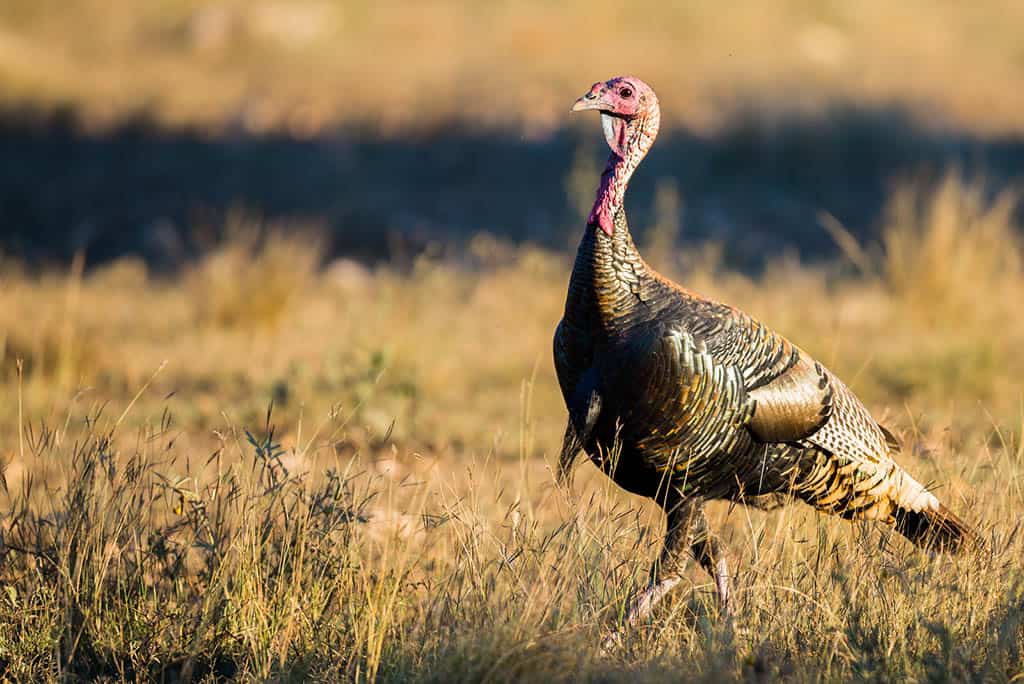
Texas Turkey Walking At Sunset

Bows: Aim for the Center of Mass

With a bow, a shot can be made from nearly any angle. You have to keep one thing in mind, however, a turkey’s body is actually a lot smaller than it looks. A bow will easily provide the penetration to get through the feathers and denser muscles, but you have to be very careful where you aim with it.

Aim for the exact center of mass of the bird, the arrow should penetrate the vitals and provide a relatively speedy kill.

While you can kill the bird from nearly any angle with a bow, most hunters will actually find a broadside shot to be the most difficult. This poses a problem since it’s the most common way to encounter the birds, but you have to be able to calculate where the feathers are and where the center of the bird is in an instant.

From the front you’ll want to aim a few inches below the base of the neck, while from behind it’s easiest to aim for the center of the fan. An ideal shot from behind will go through the bird’s vent and into its vitals with a surprising amount of ease.

If the bird is strutting, it’s important not to get confused by the feathers which will be fanned out. Always draw your aim point from somewhere relatively bald like the neck or backside in order to find the perfect shot.

From the broadside, it’s easiest to aim through the wing. If the bird is currently strutting, it may be best to wait until they’ve finished their cocky walk since the feathers can make the mass of the turkey hard to estimate from this angle.

Wild Male Turkey

Scouting for Wild Turkey

One of the first things you need to do before you go on a hunt is to make sure that you know the area where you’ll be chasing your quarry. Location makes all the difference when hunting and you need to both know the terrain and where to find them when you set out. This is especially important if you’re planning on setting up a blind.

After you’ve confirmed that they’re in the area, watch where they spend their time and when they’re not there go down and scout out the area on foot. You want to figure out where they’re eating and drinking and what paths they’re likely to take while there.

You want to find somewhere they’ll be in the open but you can take your shot from concealment in order to maximize your chances.

If you’re just trying to locate them in the first place, water is your best bet. Where there’s water, you’ll usually be able to find the birds. Keep an eye out for v-shaped scratch marks on the ground and turkey droppings, both are big clues that you’re in the right area.

Most hunters prefer to make sure they have trees to their back, it will help to break up your silhouette and keep the birds from noticing you until it’s too late.

Others prefer brush piles, which will also break up the silhouette but you need to be careful not to make much noise when moving through them. The key is to arrive early so a little bit of noise doesn’t scare them off, as with most hunting it’s quite likely you’re going to be doing some waiting before you get a chance.

While you’re scouting, do your best to avoid alerting the birds to your presence. A turkey that knows there’re humans in the area is going to be quite wary when the time comes for your hunt and that’s not a good thing.

A male turkey separated from his hens looks for them in the brush

Knowing Your Area

If you’re lucky enough to live close to where you’ll be hunting the turkey, then you actually have a leg up on anyone else. Keep an eye out for the birds throughout the year and you can learn a lot.

In areas where there’s a lot of public land open for hunting, this is a particular advantage to the hunter. You can find areas where there’s frequent sightings, or even road kill of the birds, and revisit them later and you’ll have a good idea of where to scout on foot.

Keep in mind that turkey have a tendency to make their homes at the bottoms of hill, near water. Unfortunately, they also tend to wander quite a bit, they don’t roost in the same place at all times.

The home advantage is definitely something you should be taking advantage of if you can however.

Spring Scouting

When scouting in the spring the birds are more likely to be active. This is their mating season, after all, which means they’re going to be a bit less alert to human presence due to their focus being elsewhere.

In the spring, turkey will tend to be active in their breeding ranges, as opposed to the fall where they’ll be much more actively searching for food to fatten up for the winter. This means that a spring season will generally have you looking for turkey in different areas than you’d find them in later in the year.

During spring, turkeys will generally be eating a lot of small insects which can be found in grass. Use this to your advantage and find open areas with cover around the sides then inspect them for signs that the animals are using the area.

Places where the snow will be melting are great if you’ve got the time before the season begins. Turkey love to eat acorns and other foods which might be covered in snow for part of the year and these areas make a prime location for their feedings.

In the spring you’ll also find that they tend to use dust bowls in the middle of the day and setting up an area between the dust bowl and a roosting site that you know is being used can be a great way to ensure that you make your bag limit when the season comes.

Fall Scouting

During the fall season, water is often quite a bit harder to find so you should focus on areas where it’s still present. Turkeys, like anything else, need food, water, and shelter in order to survive.

During fall the birds are more wary, and will tend to stick along the edges of wooded areas. They’ll still eat just about anything, but their diet seems to primarily shift to plants during this time of the year.

Look for signs along edge cover near water and you’ll be on the right track. The birds don’t like to get too far from water for most of the year, but with it being more rare after the summer has come along and evaporated much of it it’s your best sign.

Turkeys also drop far more feathers later in the year, which can add to the signs you should be looking for when determining if an area is a good spot for a turkey hunt.

Attracting Turkey

If you’re lucky enough to have access to land which is good for turkey, then you might want to put some thought into attracting the birds. It’s a lot easier than you’d think, and by creating a good environment for them you’ll both know where they are and be able to find the good ones when the season comes around with ease.

Turkey are actually rather particular about where they’re living, so it’s a little bit of a specialized hobby but the end result is well worth it.

Wild Turkey

Foods

Of course, you’ll have to have land which is suitable for the birds in order to have any hope of getting them there in the first place.

Turkey like mature, wooded areas which can provide quite a bit of cover. One of their favorite foods is acorns, but they’ll eat pretty much any kind of mast. The best area would have mature oak growth, access to berries, and some grassy areas to attract their favored insects like grasshoppers.

Acorns are particularly critical during the winter months, when many other plants cease to produce foods edible for the birds almost entirely. Encouraging the growth of other suitable food plants in and around an oaky area will help to get them flocking to your backyard.

Water Access

As we noted before, turkeys need water. The best areas will have a stream, creek, or pond naturally occurring there but you’re not entirely out of luck if your chosen property doesn’t have natural water features.

You can install your own self-filling water fixtures, even large bird baths with a pipe running to them can be a good source of water for the birds.

The more water sources around the better.

Read more: The 10 Best Turkey Hunting Boots

Shelter and Environment

You also need to make sure that there are numerous areas suitable for the birds to roost in spread over the property . Since they don’t like to bed down in the same spot every night, spreading them out across the area you intend to hunt in is an ideal way to make sure that they stick around.

If the whole area you’re planning to use is heavily wooded you might want to consider making your own clearings in the woods. Turkey will take advantage of these and they’ll also give you an appropriate shooting lane when it comes time to harvest.

Allow weeds to flourish in some areas, the birds will graze on them. They also add to the cover, making the turkey feel secure, and encourage insects which are vital for young turkeys and a welcome addition to the diets of the older ones you’ll be hunting.

Add all of these factors together and you’ll have a property which is amazingly attractive to the birds and you might soon have a flock or two of your very own roaming the property.

Using Decoys

Like most birds, turkey have some predictable behavior that can be taken advantage of in order to increase your chances of making a kill.

Turkey decoys are actually a rather new development in turkey hunting. Many still forgo using them, but most find them to be an essential part of the overall strategy.

Used in conjunction with calls and proper scouting, and you have a winning combination of tactics that virtually guarantees a kill for a hunter who knows how to use their weapon properly.

Modern turkey decoys are quite realistic, and you’ll need to know how, and when, to use them. Most hunters will want a full set of decoys, that means jakes, gobblers, and a couple of hens.

Turkey Hunting Blind Setup

This will allow you to present a variety of situations to a turkey in order to lure it. Frequently they can be used to not only bring a turkey in, but with careful placement you can also ensure that you have a clean shot from the angle you prefer.

There’s three main strategies which most hunters will want to try:

1

Before the breeding season, you can set up a jake and a couple of hens, making it appear that the jake is initiating breeding. This can get a gobbler right in your sights, as they know they can easily overpower a single, younger male and take the female for themselves. The other hens should appear to be grazing, as this will tempt the gobbler further.

2

During the breeding season, you’re best off with just a single hen placed strategically to allow you to get some shot placement. Turkey, like most animals, are less wary during the breeding season and combined with calls it should be all you need.

3

After the breeding season most gobblers have had their fill, but the sight of three or four hens might tempt even the most wary bird into letting his guard down enough to get your shot in.

The key here is to make sure that everything is set up close enough to your position that you can take the shot even if the bird realizes that something is amiss, roughly 20 yards away is good in most cases.

Bringing Them In With Calls

Unlike decoys, calls have been used since times immemorial for bring turkey in. There’s quite a bit to learn, however, in order to make sure that you get perfect.

Types of Call

There’s a few different types of call, and each is good for a specific purpose.

1

Tube Calls

Are the most versatile of the lot, but they require a lot of practice to get just right. Using one you can replicate nearly any turkey noise, even gobbling, and use it to manipulate their behavior in your favor.

That said, they’re also a lot harder to use than any of the other types of call.

2

Friction Calls

 are much easier to use, relying on a mechanical device to create the noises you need to manipulate behavior. In most cases, you’ll be rubbing a device over a surface. They still require some practice, and they’re not quite as versatile as tube calls, but they’re a valuable addition to the pack of most novice hunters.

3

Locator Calls

 are particularly good for those who aren’t hunting from a single position. They mimic the sounds of different species of raptor, which will get the birds nervous. Nervous toms will commence with their gobbling, which can help you easily find them.

4

Diaphragm Calls

are the best of the best, but they require more practice than just about any other kind of call. Also called “mouth calls” they can even be used hands-free, allowing you to manipulate your weapon as well as calling the bird in at the same time.

Practicing Your Calls

After you’ve decided on a call you’ll need to mess around with it for a while to figure out how to use it properly. One of the best ways to get in some practice is to wander around in areas with turkey in the off-season and see if you can elicit any response from the birds.

Related: The Ultimate Comprehensive Guide on How to Call Turkey -Turkey Calling Tips

You can have a lot of fun in the off-season doing this, and by the time the next season rolls around you’ll be able to know what works and what doesn’t. Experience is the best teacher, and it’s easier to do it when there’s nothing on the line.

bigstock Turkey Hunter 6215240

Tips for Using a Ground Blind

Ground blinds are a vital tool if you’re a stationary hunter, and they’re quite easy to set up when you’re out for turkey. Turkeys really aren’t spooked by blinds, so you can set one up in your favored way once you’ve scouted out the appropriate area.

Keep the following in mind, however:

Turkey Hunting Blind Setup

Keep your back to the sun

While the blind itself might not bother your prey there’ll definitely be some problems if they see you moving in it. Having sunlight shining on you will highlight this, so you want to be in the shade in order to avoid missing your chance at a big gobbler.

Keep your line of sight clear

 Many hunters worry too much about staying hidden from the turkey to the point they set their blind up somewhere they don’t have good visibility. Avoid making this classic amateur error, if you can’t line up your shot then it really doesn’t matter if the turkey sees you or not.

Location is key

If you’ve scouted the area you should have things just about right but hunting is never a perfect affair. If your blind ends up being in a bad position, figure out how to adjust the conditions around it to make everything line up perfectly and come back another day.

This is why scouting before the season begins gives you such a huge advantage. Setting up where they’ll be feeding, drinking water, or even roosting will make sure that you can at least sight them and if you’ve done everything else properly you’re pretty much assured of a kill.

Dusting sites, where the turkey cleans themselves, are also a great place to set up with the bonus that the bird will be making a bit of noise and should be a little bit more distracted than in most other places.

General Advice for Nabbing a Big Gobbler

Of course, you can’t cover everything about a turkey hunt just by reading, but we aim to get you as close as possible. Here’s some general advice for both of the common seasons of turkey hunting to give you an even better chance of having the best season yet.

Hunting in Spring

Since spring is the turkey’s mating season, your best bet with calling is to play the part of a hen.

When you’re doing this, patience is key. Many hunters either call to frequently or try to make a move far too early in the game. Your goal is to get the turkey within 20 yards or so, allowing you a clean and easy shot.

Don’t give up. Hopefully you’ve practiced enough that you know how to make a hen’s cackle with the call, as well as some of the basic yelps.

If your calling isn’t quite up to par yet, hopefully your scouting was. If this is the case, then one of the sneakiest tactics is to find areas where the hen gather and get between the gobbler and them. They’ll be hell-bent on breeding, so they’ll be a little bit less cautious than normal and you’ll know where they’re coming through.

If you set up a blind in this area, you’re virtually guaranteed to get close enough for a shot as long as you did your scouting out properly.

Scouting is always your best friend, and keeping an eye on the habits of the flock in the area you’re hunting will give you the edge you need for whichever kind of hunting you prefer. The most important thing is to know roughly where they are and what they’re doing for the duration of the day.

If it gets hot in the spring where you’re hunting, make sure to check shadier areas even if the birds aren’t normally common there. They don’t like the heat, so they try to stay out of direct sunlight when the temperature is high.

Try to hunt when it’s clear. If the rain is mild the birds might still be active, but for the most part they’ll be trying to stay out of the rain which can make it a lot harder to get a clean shot.

Wild turkey hunts for food in spring valley

Fall Hunting

Fall hunting is a little bit different. The birds are bound to be a little bit less concerned with breeding and more concerned with their day-to-day poultry affairs, which includes staying away from large predators like humans.

Related: Get Rid of the Darkness: The 5 Best Hunting Spotlights

This means you can switch things up a little bit. While in the spring they’re bound to be wandering to mating grounds, in the fall they’ll tend to be together in larger flocks which opens up some interesting ways to get them.

One of the best tactics is to engage in flushing the birds. Forget stealth for the moment, and try to spook the flock and scatter them.

If you’re in a state where it’s legal to use a dog, this is a good time, but a partner will work nearly as well. Come in from opposite directions, making noise and generally moving quickly and causing a ruckus. Your goal is to get the birds to scatter.

Afterwards, you can pull back to a location where you’ll have a good shot and use your call to try to get them to regroup in an area where it’s entirely to your advantage.

If you’re planning on using a blind at this time of year, your best bet is to set up near food or water sources to wait it out. Calling isn’t quite as effective as it is in the spring for getting them to a blind during this season, but knowing their patterns is sure to nab you an excellent gobbler.

bigstock 148166087

Some Expert Advice

Each of the following articles has some rather outstanding advice for someone who’s planning on a turkey hunt.

http://www.petersenshunting.com

This article includes some great tips in a slideshow format that’ll help keep you on top of things when you’re out there. Things like keeping your back to the wind and how to control the volumes of your calls are covered in an easily readable format.

http://www.gameandfishmag.com

Some expert advice on hunting turkey in the spring season, covering everything from the uses of calls to using the terrain to your advantage. This is some highly recommended further reading.

http://www.outdoorcanada.ca

Another complete guide to hunting turkey, this one focuses primarily on hunting in the spring. They cover most of the information we’ve just gone over, with an extra emphasis on spring hunting. This site is primarily concerned with firearm hunting but the tips are good for every aspiring turkey hunter.

http://www.dfw.state.or.us

Straight from the Oregon Department of Fish and Wildlife is a guide to hunter’s in that state. In addition to covering the best places to hunt there and some general tips for hunting the birds, you’ll also find a ton of useful information about the birds themselves as well. Knowing you quarry is one of the most important parts of the hunt and every little bit of information helps.

Turkey Hunting FAQ

Q 1-  How can I get started hunting turkey?

A: The easiest way to get going is to get into the field. For a beginner, the following should be sufficient:

  • A box call
  • A full length shotgun
  • Woodland camouflague BDUs
  • A hunting license
  • Somewhere to hunt

You don’t need a lot of decoys or a fancy call for your first hunt. The above will be enough to get you going, and if you get lucky you might still score a kill. While the gadgets and toys are nice, some camouflage clothing and a shotgun is more than sufficient for a beginner, as long as they have somewhere to hunt.

Q 2-  What’s the best time to hunt turkey in the fall season?

A: Fall hunting is quite a bit different than spring hunting, calls and decoys are less effective and this means choosing the right time of the day. If you’ve done your scouting for a while before hand you’ll have a good idea of the bird’s patterns but we don’t always have that luxury.

The ideal time would be as soon as legal light shows up, meaning you can hit them in their roost. Turkey are entirely diurnal, however, and will be foraging for food, finding water, and wandering their range as long as the sun is up.

This means finding them is more a matter of knowing your flock and terrain, rather than their being a particularly ideal time to set out.

Q 3- Can I hunt turkey with a long bow?

A: Long bows are perfectly fine for turkey, in fact anything forty pounds and up will have no problems with penetration provided that you shoot from the proper distance. You really don’t need a compound bow for this kind of hunting.

What’s more important than the bow itself is making sure that you have the right broad heads to drop the bird, rather than just wounding it, and making sure you know how to get a kill shot on the center of mass rather than just winging the bird.

Q 4- Can I hunt turkey with a pellet gun?

A: Check your state laws first. Taking game outside of the law is unethical and hurts the appearance of all hunters. As far as we know, it’s only specifically allowed in California, Michigan, Pennsylvania, and Virginia.

That said, in the states where it’s allowed you can generally shoot at turkey with a .20 or higher caliber pellet gun. We recommend at least a .22, although a .25 would be a better platform. With high FPS and a heavy pellet, a headshot should be able to drop an adult turkey quite effectively.

Do not do body shots with an airgun. The projectile isn’t large enough to ensure a clean kill. Aim for the head, it’ll be a challenging shot but it can be done.

Q 5- What’s a good .22 air rifle for hunting turkey?

A: If you’re intent on using an air gun to hunt turkey, you need to make sure it’s a good one. We strongly recommend the Benjamin Trail Nitro Piston 2.

One additional word of advice if you choose to use an air rifle: make sure it’s properly broken in and you have plenty of practice with the pellets you plan on using to hunt.

Filed Under: Turkey Huning Tagged With: none ad 20:57 by Kevin Steffey

  • « Previous Page
  • 1
  • …
  • 37
  • 38
  • 39
  • 40
  • 41
  • …
  • 49
  • Next Page »
  • AffioraTool Privacy Policy
  • AffioraTool
  • Best Shooting Rest Reviews For A Perfect Hunting – Best Shooting Rests Reviews
  • Hunting Safety: 5 Best Treestand Safety Harnesses Reviewed
  • How Fast Can A Deer Run – How Hard Would It Be To Catch A Frightened Deer On The Run
  • Rice Bran for Deer- How to Effectively Use Rice Bran to Attract a Deer?
  • The Best Reloading Scale for Consistent Accuracy
  • Which Shotgun Choke Is The Most Open?
  • 17hmr vs 22lr: Which one Should You Use?
  • 5 Top Coyote Hunting Dogs That Are Proven To Be Tremendous Hunters

DMCA.com Protection Status

Deerhuntingfield.com is a participant in the Amazon.com Services LLC Associates Program, an affiliate advertising program designed to provide a means for sites to earn advertising fees by advertising and linking to Amazon.com. Additionally, deerhuntingfield.com participates in various other affiliate programs, and we sometimes get a commission through purchases made through our links.