Deer Hunting Field

Hunting Blog

  • Hunting
    • Best Coon Hunting Lights
    • Best Treestand Safety Harness
    • Best Hunting Boots
    • Best Rubber Hunting Boots
    • Best Muck Boots For Hunting
    • Best Treestand Safety Harness
    • Best Hunting Spotlights
    • Best Elk Hunting Boots
  • Archery
    • Best Arrow Rest
    • Best Bow Sights
    • Best Single Pin Bow Sight
  • Gun, Shooting & Accessories
    • Best Bipod for Long Range Shooting
    • Best Scope For Ar 10
    • Best Shooting Rest
    • Best AR 15 Bipod
    • Best AR 15 Slings
    • Best ACOG Clone
    • Best Shot Timers
    • Best Rifle Bipods
    • Best Shooting Tripods
  • Survival
    • Survival Shelter
    • Finding and Purifying Water in the Wilderness
  • About Us

When Should You Carry Arrows in the Nocked Position

When Should You Carry Arrows in the Nocked Position

Knowing when to keep an arrow on the string can be pretty tricky and it’s a divisive subject among bowhunters. The truth is, it’s a complicated subject and it will depend a lot on you and your equipment to make the right choice. So if you were hoping for a quick list of situations it’s appropriate to settle an argument… well, that’s not going to happen.

Instead we’ll educate you on the subject. So the next time someone asks when should you carry arrows in the nocked position you’ll be able to give them a quick run down.

When Should You Carry Arrows In The Nocked Position? A Quick Word About Bow Safety

A Quick Word About Bow Safety

The buck above was hit with a broadhead arrow. Falling on one will do pretty much the same thing to you.

Most people assume that hunting with a bow is much less dangerous than going out with a rifle, but the truth is that falling on an arrow kills a few people every year.

Gun accidents tend to be more common, but that has two factors to it. The first is that guns tend to be favored by inexperienced hunters, and there’s simply more people out there with a rifle than a bow in any given year.

Related: Ultimate Buyer’S Guide For The Best Bow Sights

When you read the following, remember that walking with a nocked arrow is always going to be riskier than keeping the shaft in your quiver. We’re also going to discuss your personal skill level a bit, and it’s important that you don’t become overconfident and instead realistically assess where you’re at.

Equipment Considerations

Equipment Considerations

One of the most important things to take into account while you have an arrow knocked, particularly if you’re moving, is the point of the arrow you’re carrying. Blunt, bullet, and field points aren’t all that risky most of the time, but they can still cause serious injuries.

Walking with a broadhead on your bow is asking for trouble, particularly the expandable types. These arrows are meant to kill something the size of, or larger than, a human and they can certainly inflict a grevious injury.

Severing the femoral artery is an easy way to bleed out in a matter of minutes, meaning even an arrow through the leg has potential for fatal damage.

Take into account the rest of the factors here before you decide one way or the other, but we absolutely can’t recommend moving with a broadhead anywhere but your quiver in good faith.

See also :

  • Choosing Arrows of the Right Length – a Complete Explanation
  • How to Cut Carbon Arrow

Terrain is Important

Arrow-Rest-Selection-Tip

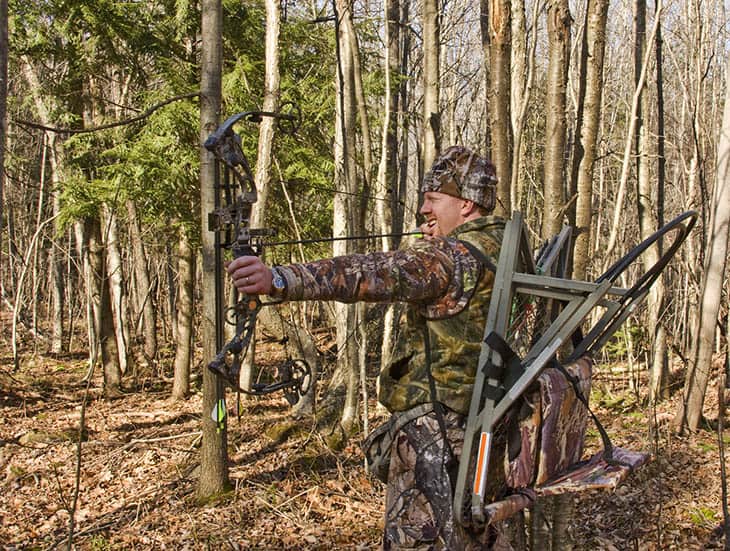
The terrain you’re on is a huge factor in whether or not you should be hunting with an arrow nocked. While in open, flat fields it’s generally safe you should definitely quiver the arrow if you’re on any kind of steep slope.

Another factor, in addition to safety, is the kind of flora you’ll be moving through. Arrows can snag on woody brush pretty easily, which makes noise and poses a risk of the arrow getting in you. The noise is the big reason.

Unfortunately, while in woods with a floor covering of brush is also one of the situations you may need an arrow the quickest, so it’s a trade off.

Put the arrow back if you’re on steep or uneven terrain. The fall risk simply isn’t worth it even if you’re part mountain goat.

If you’re hunting with a partner then keep the arrow put away Risking your own safety is one thing, but putting someone else at risk is absolutely unacceptable.

Anytime there’s more of a fall risk than normal, you don’t want the arrow at the ready.

Your choice in brush is pretty much up to you, but be extra careful around anything strong enough to knock the arrow off the string. Keep a tight grip regardless, dropping your arrow is dangerous to you and it can damage specialized broadheads as well.

Type of Hunting
Type of Hunting

The type of hunting you’re doing is also a big factor in your decision.

When you’re hunting on foot, there are basically two different “modes” you’ll be in.

Traveling refers to when you’re moving at a fairly brisk pace. Think of when you’re walking down the trail to where you’re planning on hunting. At this point there’s no need to increase the risk since it’s unlikely you’ll encounter any game.

Stalking is when you’re moving very, very slowly and using your senses to find game. If you’re a slow stalker, which is definitely a good thing, then having an arrow nocked can be a good idea. Just don’t focus on the arrow too much, as long as it’s on the string your risk of hurting yourself is pretty low.

Instead focus on being sure footed. Anyone who’s ever moved quietly on foot knows how careful and slow can be. If you need to hurry, then remove the arrow from the string until you’ve slowed down again.

Hunting from a tree stand or blind is a bit different. Since you’ll be stationary many hunters will keep an arrow nocked the whole time, waiting for their chance to get a shot. It’s not risk-free, but it’s a much different affair than when you’re actively moving.

Just make sure you have solid footing regardless.

Related: 

    ➜ Hunting Safety: Picking the Best Treestand Safety Harness

    ➜ How To Build A Deer Blind-Anyone Can Do it! How to Build a Box Blind

Your Abilities

You’ll need to assess how solid on your feet you are. If you’re naturally clumsy, then you’ll only want to nock an arrow during the final approach on game, this might mean a lessened chance of getting the shot, but it’s a lot better than bleeding out in the woods.

If you’re naturally careful and sure footed, then you’ll definitely be safer with an arrow nocked. Just remember not to be overconfident, accidents can happen and coming back empty handed is better than not coming back at all by a long shot.

Conclusion

Knowing when you should carry arrows in the nocked position can be a large part of hunting, but depending on the terrain, situation, and your own skills it’s largely a matter of common sense and personal judgement. If in doubt, leave it in the quiver. Be safe and enjoy your trip regardless, the tale of a buck that got away because you couldn’t get to your quiver in time is much better than getting hurt.

We know this is a divisive subject, care to throw your two cents in? Leave us a comment below.

More Hunting Gear & Resources

  • The Best AR 15 Bipod Reviews Today That Will Improve your Hunting Skills

  • Shoot Straight! The 5 Best Rifle Bipods Reviews

  • Best Shooting Stick: Top Shooting Sticks That You Can Get In The Market Now (#2 Should Really Please You!)

  • Best Shooting Rest Reviews For A Perfect Hunting – Best Shooting Rests Reviews

  • Best Bipod for Long Range Shooting – 100% Accurate Buying Guide

  • Best Shooting Tripods Reviews – Make the Perfect Shot with One of These Top Tripods

  • Best Muck Boots For Hunting – The Perfect Pair of Muck Boots Makes For The Best Hunting

  • What are the Best Rubber Hunting Boots – The Hunter’s Guide (Updated)

  • Best Shot Timer: Things to Know About the Top 10 Great Shot Timers

  • 13 Best Hunting Spotlights: Essential Gear Review for Hunters

Filed Under: Archery 03:26 by Kevin Steffey

What Is The Main Difference Between Centerfire And Rimfire Ammunition

What Is The Main Difference Between Centerfire And Rimfire Ammunition

When it comes to ammunition there’s a lot of technical language that can go over the head of the novice. One of the main things that is confusing to beginners is figuring out what is the main difference between centerfire and rimfire ammunition.

If you’ve been wondering, we’re here to answer your question and give you some further information to help you figure out which type of ammo is best for your needs.

The Location of the Primer

Centerfire and Rimfire

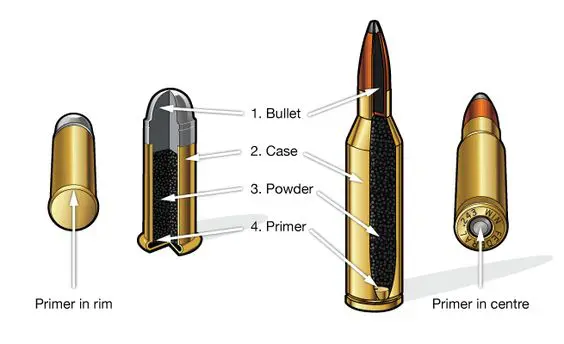
The location of the primer is the thing which determines whether a cartridge is considered to be rimfire or centerfire.

The primer is a small piece of shock sensitive explosive which explodes when the firing pin hits it. While the explosion is quite small, it is enough to ignite the powder contained within the cartridge. The expansion of the gasses then propels the bullet from the shell casing.

Rimfire rounds will tend to be smaller. While it’s certainly possible to use them in a larger round, the construction of the case of the cartridge has to be small and light in order to allow the firing pin to ignite the whole process.

In modern times they are really only available in .22 and .17 rounds, pretty much any other gun will utilize a centerfire primer.

Centerfire rounds are much more common, with nearly all rounds larger than a .22 being made with this type of primer.

The process is quite similar to a rimfire cartridge, but instead of striking the edge to create the initial spark for the gunpowder it strikes the center. The primers are contained in a small metal cup in the center of the round.

The reason for switching primarily to centerfire rounds is pretty easy to see if you’re a fan of reloading your own ammunition. Brass cartridges are expensive, and you can reload the round since the casing isn’t usually damaged in the process of firing one.

FURTHER READING:

➜ What Are The Basic Parts Of Ammunition?

➜ How Far Can A Bullet Travel? How Far Does A Bullet Travel

➜ How To Hold A Rifle Steady – The Best Way To Hold A Rifle Steady

Rimfire vs. Centerfire Pros and Cons

Rimfire vs. Centerfire Pros and Cons

https://www2.huntercourse.com

Each type of primer has their own advantages, and while you’ll be limited to one type or the other depending on what type of rifle you’re using it can help to illustrate the difference if you delve into the advantages and disadvantages of each.

Rimfire Pros and Cons

Rimfire-Pros-and-Cons

Rimfire cartridges are cheaper. There’s simply less brass in the case, and it’s still an ideal way to manufacture smaller caliber rounds since they can be produced quite cheaply in lots since they require less materials.

Related:

​Shoot Straight! The 5 Best Rifle Bipods Reviews

30-30 vs 308: The Best Deer Cartridge Showdown 

The .22LR is the most common round in the world and is a good choice for small game hunting and target shooting, since it has a mostly flat trajectory and won’t tear the meat and pelt up.

Most of the advantages given to rimfire ammunition come solely from the fact that it’s only made in lighter calibers.

The most powerful round using this kind of primer is probably the .22WMR, a magnum round that punches a pretty good punch for being so small.

They’re light in recoil and usually quite accurate, which is one of the reasons why most shooters will find themselves with a .22 of some variety on their first few outings.

That said, more experienced shooters rarely use them for most applications after they get used to getting a good sight picture and get down the basics.

The thinner case is the main thing that keeps more powerful rounds from being manufactured with a rimfire primer, the brass won’t hold up under the pressure required to lob a super powerful shot.

They also can’t be reloaded since the casing will be damaged irreparably after they’ve been fired. This can be a hassle, and means you’ll have to get down to the store in between outings if you manage to shoot everything you have in your bag.

This normally isn’t a problem, since .22LR are extremely cheap but those who are planning on using .17 of any sort should keep in mind that those rounds are usually quite high-tech and they can cost a significant amount more than .22 rounds.

There’s generally a dud or two in each box as well, they’re not quite as reliable as centerfire rounds. This can be alleviated to some extent by buying only high-quality ammunition, but it’s not a guarantee that they’ll all fire perfectly.

Related:What Are The Basic Parts Of Ammunition?

Essentially they’re best for plinking and small game, but they can’t be reloaded and any high-powered round is going to be centerfire.

Centerfire Pros and Cons

Ammunition

Centerfire rounds make up pretty much any powerful round that you’re able to buy. Since the brass doesn’t have to be damaged by the firing pin the casings can be much thicker and that means more powder and larger projectiles.

They’re also quite a bit more reliable than rimfire cartridges. This is because the primers are standardized and inserted separately, while rimfire cartridges have a wet primer placed in them and are then spun to get it to the edges of the case.

They also tend to leave less residue in your gun after firing since the powder burns more evenly. You should still be careful to clean your guns after putting rounds through them, but they’ll be able to be fired more times before the excess, partially burned powder causes problems.

The biggest advantage is, of course, reloading. You can reload a centerfire cartridge pretty easily, but make sure you pick primers that will be used within the amount of time you have before their shelf life expires. This allows you to customize the ballistics of your shot quite a bit, however, and many experienced hunters and marksmen get into reloading pretty quickly.

The only real disadvantage of centerfire ammunition is that it costs more per shot. This can be mitigated quite a bit by reloading your own shots, but it’ll still be a pricey affair at the end of the day.

Conclusion

Knowing the main difference between centerfire and rimfire is only the tip of the iceberg when it comes to understanding all of the intricacies of ammunition as a whole but it’s probably one of the most important differences for a newbie to understand.

Have a favorite round? Comments on our commentary? Leave us a line below and we’ll get back to you.

Filed Under: Gun, Shooting & Accessories 01:53 by Kevin Steffey

How To Shoot A Slingshot- Steps on How to Shoot a Slingshot Accurately

How To Shoot A Slingshot- Steps on How to Shoot a Slingshot Accurately

Slingshot is a fun activity and is an excellent way to hone and improve your hunting skills. However, it is best to learn the basics of using a slingshot for safety and proper form to ensure that there will be no damages or casualties.

Slingshot should be considered as one of your weapons that should be handled with care and with full responsibility. So, read on and learn to be expert on this field through the following guided steps on how to shoot slingshots accurately.

Related: How To Aim A Slingshot – 4 Easy Steps to Superior Slingshot Accuracy

We have laid out all the needed steps for you to enhance your skills. We have also made sure to provide you the easy tips to use a slingshot properly. The following are the clear steps for you to follow.

Here’s What To Know

You can also watch this video:

First, gather everything that you will need.

The following are the recommended things that you should have while learning how to shoot a slingshot. Be sure to have these beforehand, so you will be able to save time and direct your focus on learning instead of going back and forth to find your materials:

  • A slingshot
  • Ammos

It is recommended to use round and dense objects. For your ammo, you can choose from marbles, fishing sinkers, arrows, glass balls and even small rocks. However, marbles and ball bearings are the best to use as they have striking colors which makes it easier for you to trace and evaluate your shots.

Ammunition Loading

Once all the needed materials are gathered. It is now time for you to start loading your ammo. You can do this by holding the bottom part of it with your hand which you are most comfortable using. Your opposite hand should place the ammo at the center part of the pouch and make sure not to let the ammo swing away since it will not contribute to your accuracy and precision.

To keep the bullets or marbles in one place, use your fingers, specifically your thumb and index finger. Also, ensure that the thumb and the strap are in parallel position with each other.

Ammunition Loading

The Proper Way to Aim your Shot

1

Hold It The Proper Way

Of course, you would prefer to hold the slingshot through your principal arm for you to have a better shot and for a more comfortable posture while shooting. You can then use your secondary arm to yank back the ammunition. This will allow your principal arm to get the needed strength to keep the slingshot steady while releasing the shot.

Then, you should hold the slingshot perpendicularly or flatly. You can do this by holding the slingshot up and raising your arm. There are a lot of shooters who prefer to keep the slingshot allowing the forks to be pointed upward while there is other that prefer to angle it slightly to the side.

One thing needs to be remembered is that slingshot comes in different sizes. There are those who are lengthier, while other are wider or narrower. So, you may need to make some changes with the way you handle the slingshot according to its form and size.

2

Be Mindful Of Your Stance

Your position will determine how confident and comfortable you are while you aim. So, if you are a righty person put your right forward while making your left foot be positioned behind and slightly pointed outward. Your knees should be bent slightly. The entire lefty person must do all the opposites of the above directions.

Also, this will allow you to form a solid base by keeping your feet facing forwards and be even with the width of your shoulders. Feet that are held close prevents you from getting a perfect balance and aim your shot accurately.

3

Sideways Is The Best Way

The principal arm’s shoulder which you will be using to hold the slingshot should be fronting the target. To do this, put the slingshot up perpendicularly and ensure that it is marginally slanting away from you. This will provide you ample space to free your arm to draw the slingshot band.

4

Don’t Forget To Breath!

Draw a breath into your lungs, and then ultimately release it. This will make sure that slight movements caused by breathing will be eliminated and can improve your aim while taking the shot. Also, you should learn to take the shot during your body’s natural respiratory pause or (NRP).

5

Get Ready To Fire

Give yourself time to aim slowly to your target. Position your head in a way that it is marginally allowing you to check your target while making sure that you are also clear from the bullets. You should take use of your dominant eye when targeting while closing the other. However, you should train yourself aiming your target using both eyes amidst the visual restrictions since this will help you improve your performance and skills in the future.

Ready to Fire and Shoot

Once you are ready with your hand and posture, it is time for you to fire your shot. Here are the following things to consider when shooting.

Hold It The Proper Way

Tug The Ammunition Using The Open Hand

Pull the band until completely stretched and make sure that all the triangles are visible and shaped by the splits of the slingshot.

Discharge The Band

Shoot the ammo and hit the target by flicking your wrist forward. Also, make sure that your thumb is not in the way of the projectile as it leaves the sling since this can be very painful and may cause injuries.

Conclusion

Now that you have the necessary steps for you and the proper slingshot shooting tips, you should be more comfortable and confident now as you have already learned the basics. One thing that you should always do is to keep on practicing and continue learning for you to improve and hone your skills. There is no better way to improve yourself but to keep on practicing and practicing until aiming and shooting become so comfortable for you.

Keep on learning and help us improve ourselves by leaving your comments and feedback to let us know what you think of this article. One thing that we can assure you, we will be with you throughout your whole slingshot journey.

Filed Under: Hunting 07:43 by Kevin Steffey

  • « Previous Page
  • 1
  • …
  • 30
  • 31
  • 32
  • 33
  • 34
  • …
  • 44
  • Next Page »
  • Best Shooting Rest Reviews For A Perfect Hunting – Best Shooting Rests Reviews
  • Hunting Safety: 5 Best Treestand Safety Harnesses Reviewed
  • How Fast Can A Deer Run – How Hard Would It Be To Catch A Frightened Deer On The Run
  • Rice Bran for Deer- How to Effectively Use Rice Bran to Attract a Deer?
  • The Best Reloading Scale for Consistent Accuracy
  • Which Shotgun Choke Is The Most Open?
  • 17hmr vs 22lr: Which one Should You Use?
  • 5 Top Coyote Hunting Dogs That Are Proven To Be Tremendous Hunters
  • Best Shot Timer: Things to Know About the Top 10 Great Shot Timers
  • Elk Hunting 101: 5 of the Best Elk Hunting Boots

DMCA.com Protection Status

Deerhuntingfield.com is a participant in the Amazon.com Services LLC Associates Program, an affiliate advertising program designed to provide a means for sites to earn advertising fees by advertising and linking to Amazon.com. Additionally, deerhuntingfield.com participates in various other affiliate programs, and we sometimes get a commission through purchases made through our links.